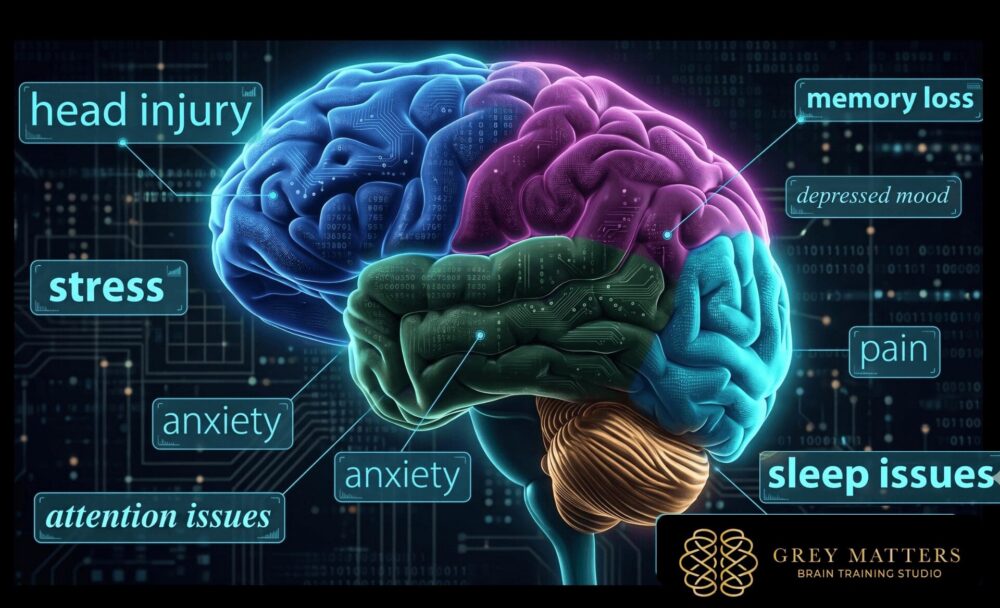
How to Increase Your Brain Capacity — And What “Using 100%” Really Means
Read Time:
10.6 minutes
Categories:
Share This:

When you think of reaching your “peak potential,” career ambitions, financial goals, athletic accomplishments, or educational achievements probably come to mind. Often, we only consider these kinds of external attributes — meeting goals and building a successful life materially — when thinking about peak potential or peak performance. But unless you are able to attain your full potential internally, you’re more than likely going to struggle to reach it externally.
If you’re an athlete, I’m sure you already know that your overall performance is just as much mental as physical. The same is true for busy moms, hustling entrepreneurs, dedicated students, hard working executives, and everybody else. Your life is a reflection of how well your brain is working. If your brain isn’t in top condition, your body won’t be at its best and neither will your life.
At Grey Matters Brain Training Studio, we define peak potential as your brain’s ability to reach a higher level of operation that gives you the clarity, productivity, and motivation to be mentally healthy and actively pursue your life goals. Because your brain influences literally everything in your life, when it’s functioning at maximum potential, all other areas of your life — relationships, career, health — run more smoothly.
It’s simple. When your brain works better, your life works better.
Can You Really Use 100% of Your Brain? Here’s What the Question Is Actually Asking
Scans show activity buzzing throughout your entire brain at all times — even when you are resting or sleeping. Not every neuron fires simultaneously, but your brain is in a constant state of readiness, with all 86 billion neurons electrically charged and ready to respond.
So the short answer is: yes, you already use 100% of your brain. The idea that we only use 10% is one of the most durable myths in popular science — and it has been thoroughly debunked.
But here is what that myth was really pointing at, even if it got the biology wrong:
Most of us are not getting the best performance out of the brain we have.
That is the real question. Not “how do I use more of my brain” but “why is my brain — which is running all the time — not working the way I need it to?” That gap between a brain that is technically active and a brain that is genuinely optimized is where the real conversation begins.
Think of it this way. A high-performance car runs its full engine whether it is sitting in traffic or on an open road. The engine being on does not tell you how well it is performing. The same is true for your brain. The question is not whether it is running — it is whether it is running efficiently, communicating well across its networks, and self-regulating under pressure.
That is what increasing your brain capacity actually means.
Curious what’s happening inside your brain?
A QEEG brain map shows exactly how your brain is performing — where it’s thriving and where it’s stuck. It’s the first step to training smarter, not harder.
What “Brain Capacity” Actually Looks Like in Real Life
When brain capacity is limited — not because parts of your brain are offline, but because it is not functioning efficiently — it tends to show up in very specific ways:
- Thinking that feels slower or foggier than it used to
- Difficulty focusing for sustained periods
- Memory that feels unreliable
- Emotional reactions that seem bigger than the situation deserves
- Low motivation even when the goal matters to you
- A feeling of being mentally exhausted long before the day is over
These are not signs of a broken brain. They are often signs of a brain that is running patterns that are no longer serving it — sometimes because of sleep deficits, chronic stress, or just years of habits that quietly deplete cognitive performance.
The good news: the brain is not a fixed machine. It is adaptive. And that adaptability is exactly what makes it possible to genuinely improve how it performs.
Ways to Optimize Your Brain’s Performance
When people refer to “brain hacks,” they typically mean techniques or strategies to enhance cognitive function, improve productivity, and reach full potential. It’s important to clarify that while there is no single shortcut to unlock your brain’s full potential, there are several evidence-based strategies that can help you optimize cognitive function and improve productivity. When used in conjunction with each other, they can provide a potent support system to boost your brain power.
Get More Sleep
Sleep is one of the biggest determinants of the health and function of your brain. In fact, science has proven that skimping on sleep, over time, can make you sick, overweight, and stupid. After a single night of reduced sleep, reaction times, glucose levels, mood, memory, and hormone balances can be negatively affected. Getting sufficient sleep improves memory and learning. You want to aim for seven to nine hours of quality sleep per night.

Eat a Brain-Healthy Diet
An easy way to rapidly improve your brain’s health and performance is to support it with a brain-healthy diet. Feeding your brain well will not only help your overall health but also improve brain health and cognitive function. You have a “second brain,” called the enteric nervous system, in your gut which communicates directly with the brain in your head. What you put in your mouth directly impacts what goes on in your brain and can contribute to a clear mind or a foggy one. To get the most brain power out of your diet, you will want to include healthy fats, foods with probiotics, whole grains, leafy greens, high-fiber foods, and lots of lean protein. Hydration is also key.
Exercise Regularly
Exercise has tremendous brain benefits because it oxygenates your brain and increases blood flow. Research shows that physical exercise improves memory and thinking skills, mood and creativity, and learning while reducing depression, age-related decline, and the risk of dementia and Alzheimer’s. One study found that exercising at a moderate intensity for just two hours per week increased volume in the parts of the brain that control memory and thinking.
Activity that combines thinking with movement, like ballroom dancing or tennis, is going to be of the most benefit to your brain. The Center for Disease Control and Prevention guidelines recommend 150 minutes of moderate-intensity exercise per week.
Challenge Your Brain
Your brain needs novelty to grow and stay sharp. When you do something new, you’re asking your brain to think, pay attention, and stay alert. It’s important to move your brain out of its comfort zone, where it doesn’t have to think, into the enhancement zone often by doing things that are unfamiliar and mentally challenging. Stepping out of your routine forces your brain to grow and make new neural connections.
You want to push your brain with things like learning new skills, hobbies, or sports, continuing to educate your mind, putting yourself in new social situations, and traveling to new locations. It could also be something as simple as driving a different way to work or eating a meal with your non-dominant hand. The point is to mix things up and make your brain work!
Train Your Brain
Of all the strategies in this list, neurofeedback is the one that works directly on the brain itself — not just the conditions around it.
Neurofeedback is a non-invasive, painless form of brain training that works by showing the brain real-time feedback about its own electrical activity. Through a process called operant conditioning, the brain learns to recognize and shift toward healthier, more regulated patterns — and research suggests it can continue to self-regulate at those levels after training.
Unlike general wellness habits, neurofeedback does not just support the brain from the outside. It trains the brain to self-regulate from the inside.
A growing body of research suggests neurofeedback may help improve focus, attention, reaction time, emotional regulation, sleep quality, and cognitive performance — and many clients report meaningful changes in how their brain feels and functions day to day.
If you are serious about improving brain capacity — not just managing symptoms, but genuinely training your brain to perform better — neurofeedback may be worth exploring.
But here is the important part: effective brain training starts with understanding your brain’s specific patterns, not someone else’s.
A Comprehensive Brain Map at Grey Matters uses qEEG technology to capture a detailed picture of your brain’s electrical activity — where it may be overworking, where it may be dysregulated, and what patterns are connected to the symptoms or performance gaps you are experiencing. That information becomes the foundation of a personalized training plan built around how your brain actually works.
Start with a clear picture of what your brain is doing — and a plan for what it could do.Stop Trying to Multitask
The idea of multitasking was originally used to describe a computer’s parallel processing capabilities and has become shorthand for our brains attempting to do many things simultaneously. However, your brain doesn’t work that way. Even when you think you’re multitasking, you’re not. Your brain is a sequential processor. It is biologically incapable of processing more than one attention requiring input at a time. What’s really happening when you think you’re multitasking is you’re shifting attention back and forth between tasks quickly utilizing short-term memory. Studies show that when your brain is constantly switching tasks, you are less efficient and more likely to make mistakes.
Practice Mindfulness
Practices like mindfulness and meditation can reduce stress and anxiety and enhance attention and memory. The opposite of an unfocused mind is an awake, mindful one. Very simply, mindfulness is a way of thinking. It is a mind that is aware and aware of its awareness. Mindfulness is a practice in which you train your brain to focus and notice what’s happening as it’s happening. It’s learning to direct your attention to your present experience.

Mindfulness is not a spiritual concept. It’s an active mental health practice. In your brain, mindfulness asks you to deliberately shift control of your thoughts and actions from your limbic system, the ancient instinctual, emotional brain, to the conscious awareness of your thinking brain, the frontal lobe. The frontal lobe of your brain is where your more complex cognitive processes take place. Over time, practicing mindfulness actually builds executive skills.
Reading
Learning to read physically changes your brain’s form and function. Reading regularly can improve brain and memory function and keep your brain operating more effectively as you age. Reading also enhances connectivity in the brain, reduces stress, promotes relaxation, improves sleep, and decreases the chances of developing Alzheimer’s.
Plus, it’s fun! I read somewhere that the average American reads a book a year. In comparison, the CEO of a company averages around 60 books a year. For the most brain benefits, science says to read fiction from an old-fashioned physical book — not electronically.
Ready to start training your brain?
Grey’s Plan gives you a personalized brain training program built around your goals — whether that’s sharper focus, better sleep, or relief from symptoms that have held you back.
Conclusion
In today’s world, it seems like we are all trying to do more, do better, and get ahead. People are always looking for ways to enhance their brains’ performance and productivity while pushing their cognitive limits to get more done each day. The way to hack into your brain’s full potential is to support and care for it with a healthy lifestyle, including the tips above. Healthy habits are the foundation of being able to perform at your best and achieve your goals in the short and long term.
When your brain works better, your life works better.
At Grey Matters, we are passionate about helping people actually use the brain they have — not just feel better about it temporarily. Neurofeedback brain training may help support improved focus, better sleep, emotional regulation, and relief from many of the symptoms that hold people back — including anxiety, depression, ADHD, PTSD, brain fog, and more.
Every training plan at Grey Matters starts the same way: with a Comprehensive Brain Map that shows us exactly what your brain is doing, so we know exactly how to train it.
When your brain works better, your life works better. Give us a call at (317) 215-7208 or send us a message to find out what brain training could look like for you.
Second image source: Image by timolina on Freepik
Third image source: Image by pressfoto on Freepik