
Unlock Your Brain’s Potential!
Unlock Your Brain’s Potential!
Get a qEEG Brain Map in Carmel, IN
Are you ready to take the first step toward a healthier mind and enhanced well-being? At Grey Matters Brain Training Studio, we’re excited to offer qEEG Brain Maps designed to provide you with valuable insights into your brain’s health and function.
What is a Brain Map?
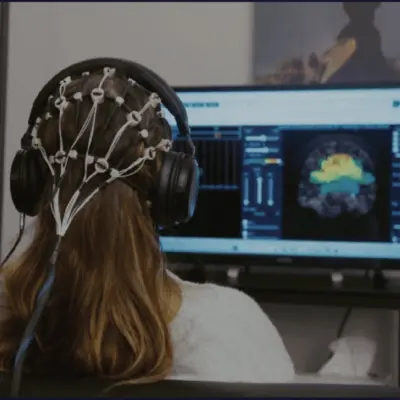
A qEEG brain map provides a detailed visual representation of your brain’s electrical activity, showcasing how different areas of your brain are functioning at any given time. This assessment can reveal important insights into various aspects of your mental health and cognitive function.
Here are some key points that might interest you:
1. Brain Activity Patterns: The brain map illustrates your unique brainwave patterns, which can highlight areas of excess or reduced activity. This information can help you understand how your brain processes information and responds to different stimuli.
2. Emotional Regulation: By examining the brain’s functioning, the qEEG can provide insights into your emotional health, showing how your brain manages stress, anxiety, and other emotional responses.
3. Cognitive Functioning: The brain map can indicate how well your brain handles focus, attention, memory, and problem-solving. This can be particularly valuable for understanding challenges you might face in daily tasks or at work or school.
4. Overall Brain Health: The qEEG can serve as a baseline for your brain health, allowing you to track changes over time as you engage in neurofeedback training or other wellness activities.
5. Personal Insights: Many individuals find that reviewing their brain map results gives them a greater understanding of their mental and emotional states, helping them make informed decisions about their health and wellness journey.
Overall, a qEEG brain map can be a powerful tool for self-discovery, providing you with valuable information about your brain’s health and functioning, and empowering you to take steps toward improvement.
Before Training


After Training


Discover Your Brain’s Unique Patterns
Gain a deeper understanding of how your brain is functioning — and how it may be influencing your mood, behavior, focus, sleep, and overall wellbeing.
Choose the Assessment That Fits Your Needs
We offer two comprehensive starting points to help uncover what may be contributing to your symptoms and guide your next steps with clarity and confidence.
- Comprehensive Brain Assessment – $597
Includes a qEEG Brain Map, written report, and full consultation with our clinician to review your results, connect findings to your symptoms, and discuss your health history, goals, and personalized training recommendations. - Comprehensive Brain + Gut Assessment – $997
Includes everything in the Comprehensive Brain Assessment, plus an at-home GI-MAP Stool Test to explore how gut health, inflammation, bacteria, and other underlying imbalances may be contributing to mental health symptoms. This option offers a more complete view of the brain-body connection and helps guide a more personalized care plan.
No matter what your symptoms are, a better brain and life is possible!
And Grey Matters Brain Training Studio is here to help!
How Neurofeedback Can Help
Neurofeedback is an effective, non-invasive therapy that has been proven to help with various mental health conditions, including:
Improving Sleep: Sleep is critical for overall health and well-being, yet many struggle with sleep disorders such as insomnia. Neurofeedback trains the brain to achieve healthier sleep patterns by helping regulate brainwave activity associated with restful sleep, resulting in deeper, more restorative sleep and reduced insomnia symptoms.
Managing Depressive Symptoms: By promoting optimal brain function and balancing neurotransmitter activity, neurofeedback helps alleviate depressive symptoms, allowing individuals to experience improved mood, emotional regulation, and overall mental resilience.
Releasing Anxiety: Neurofeedback assists in calming the overactive brain regions associated with anxiety, fostering a sense of relaxation and empowering individuals to manage their anxious thoughts and feelings more effectively.
Improving Focus: Through targeted training, neurofeedback enhances concentration and attention by teaching the brain to maintain optimal states of alertness, leading to improved productivity and performance in daily tasks.
Enhancing Memory: Neurofeedback can strengthen neural pathways related to memory and learning, supporting cognitive function and making it easier to retain and recall information, which is especially beneficial for students and professionals alike.
Brain Injury Recovery: Neurofeedback aids in the rehabilitation of brain injuries by promoting neuroplasticity, facilitating recovery, and helping individuals regain cognitive and functional abilities through personalized brain training techniques.
How It Works: 3 Easy Steps
Our process is simple, supportive, and personalized to your needs.
QEEG BRAIN MAP
We begin with a qEEG Brain Map to better understand how your brain is functioning. This gives us valuable insight into patterns that may be connected to focus struggles, poor sleep, stress, brain fog, and emotional overwhelm.
RESULTS REVIEW
Once your brain map is complete, we review the findings with you and explain what they may mean in real life. From there, we recommend next steps based on your symptoms, goals, and brain patterns.
BRAIN TRAINING
Neurofeedback helps the brain practice healthier, more efficient patterns over time. Many clients report improvements in focus, sleep, emotional regulation, stress tolerance, and mental clarity.
Frequently Asked Questions
About Brain Map
We’ve gathered a list of commonly asked questions about Brain Mapping, for your convenience. If you don’t see the information you need, please don’t hesitate to reach out to us. Simply click on the question that interests you to navigate directly to the relevant section.
A qEEG brain map is a detailed look at how your brain is functioning. Unlike an MRI or CT scan, which show brain structure, a qEEG brain map shows brainwave activity and how different areas of the brain are communicating. It helps us see patterns of overactivity, underactivity, and imbalance that may be connected to symptoms like anxiety, focus issues, sleep problems, mood changes, and brain fog.
A qEEG brain map shows how your brain is functioning in real time. It helps identify patterns that may be linked to challenges with attention, emotional regulation, sleep, stress tolerance, processing speed, or mental clarity. It is a functional tool that gives us a clearer picture of what may be happening beneath the surface.
A brain map helps us start with better information. Rather than taking a one-size-fits-all approach, we can look at the patterns in your brain and build a more personalized neurofeedback plan. It also gives us a baseline, so if we repeat the map later, we can compare changes over time instead of relying only on symptoms.
Our Comprehensive Brain Assessment is $597 and includes the qEEG brain map, a written report, and a consultation to review your results and recommendations. If you want to explore both brain and gut health together, our Comprehensive Brain + Gut Assessment is $997 and includes the GI-MAP stool test as well.
Insurance typically does not cover qEEG brain mapping for neurofeedback purposes. However, many clients use HSA, FSA, or HRA funds. Financing options may also be available.
During your brain mapping appointment, you will sit comfortably while we place a soft cap with 19 sensors on your scalp. We use a small amount of gel so the sensors can read your brainwave activity accurately. The recording usually includes time with eyes open and eyes closed, and the full appointment generally takes about 60 to 90 minutes.
Yes. A qEEG brain map is non-invasive and completely passive. Nothing is being sent into your brain. The sensors are only reading the brain’s activity. Most people leave with nothing more than a little gel in their hair.
A qEEG brain map can reveal patterns often associated with concerns like ADHD, anxiety, brain fog, depression, OCD, PTSD, concussion history, learning challenges, sleep issues, and migraines. It is important to know that it is not a medical diagnosis. It is a functional tool that helps us better understand how the brain is operating.
That is still helpful information. If your brain map looks within normal limits, it may mean neurofeedback is not the best first step, or that we should look more closely at other possible contributors such as sleep, hormones, gut health, inflammation, or stress. Our goal is to help you find the right next step, not force a treatment that may not be the best fit.
Your consultation and written report are typically scheduled within 7 to 10 days after your recording. That gives us time to carefully review the data and prepare personalized recommendations.
Yes. We typically work with children starting around age 6, depending on their ability to sit through the recording. If you are unsure whether your child is ready, we are happy to talk it through with you.
Grey Matters Brain Training Studio is located in Carmel, Indiana, just north of Indianapolis. We serve clients from Carmel, Fishers, Westfield, Noblesville, Zionsville, Indianapolis, and surrounding areas.
Not at all. The qEEG assessment is completely non-invasive and painless. A snug cap with 19 small sensors is placed on your head — the sensors only listen to your brain’s electrical activity, they don’t send any signal into your brain. You simply sit back and relax while it records your brain activity for about 20–30 minutes. Most people find it easy and restful.
Because without one, we’d be choosing your training protocol based on your symptoms and diagnosis rather than your actual brain patterns. Two people with identical diagnoses can have completely different brain maps — meaning they need completely different interventions. Applying the same training to different brains is guesswork. The brain map removes the guesswork and lets us design a protocol specific to your brain’s actual starting point. It also screens for neurological patterns that might affect how we approach training safely.
Both statements reflect genuinely different types of services. Some providers use general wellness brain training systems — classified by the FDA as General Wellness Devices — that provide the same feedback to every brain without targeting specific patterns. These can offer general relaxation and nervous system support, but they are not designed or cleared to address specific clinical conditions. At Grey Matters, we use clinical-grade, protocol-based neurofeedback guided by your individual brain map. If you’re seeking something that addresses a specific condition, history, or presenting challenge in your particular brain — rather than general wellness support — a brain map is essential to doing that responsibly.
The recording portion of the qEEG takes approximately 20 to 30 minutes. Allow additional time for setup (placing the sensor cap) and a brief review of next steps. After the recording, our team processes your data and schedules a separate review session to walk you through your results in plain language, answer your questions, and discuss what the map suggests about your training plan.
No — and we want to be clear about this. A qEEG brain map is not a diagnostic tool in the clinical sense. Only a licensed physician or qualified clinician can make a diagnosis. What the brain map does is reveal the functional patterns in your brain’s electrical activity — patterns that often correlate with specific challenges, and that guide how we design your training. In some cases, patterns identified in the map prompt a referral to a physician before training begins. The map informs our approach; it doesn’t replace the diagnostic process.
Yes, and we consider this one of the most important parts of the process. A repeat brain map partway through training gives us objective data on how your brain is responding — not just your subjective report of feeling better (or not), but visible changes in the electrical patterns. It lets us refine your training protocol based on what’s actually shifting and what still needs attention. Many clients find the progress map to be one of the most meaningful moments in their entire experience with us — seeing the change in their own brain, not just being told about it.