
What Is a qEEG Brain Map — And Why We Won’t Start Without One
If you’ve looked into neurofeedback, you’ve probably come across two very different messages.
Some clinics say: “Come in, we’ll run some sessions, and your brain will sort itself out.”
We say: “Let’s look at your brain first.”
This distinction is more than just a procedural detail—it’s a fundamental difference in philosophy. We believe it’s essential to explain this clearly, especially because we often hear from families across Carmel and the greater Indianapolis area who previously tried the initial approach elsewhere and are still searching for solutions.
At Grey Matters Brain Training Studio, every single client begins with a qEEG brain map before we run a single session of neurofeedback. Not because it’s a formality. Not because it’s an add-on we offer. Because without it, we’d essentially be guessing — and your brain deserves better than a guess.
Here’s what a brain map actually is, what it shows us, and why we believe skipping it is a non-starter.
What Is a qEEG Brain Map?
QEEG stands for Quantitative Electroencephalography. It’s a non-invasive assessment that reads the electrical activity your brain is producing right now — across multiple regions, at multiple frequencies — and compares those patterns to age-matched normative data.
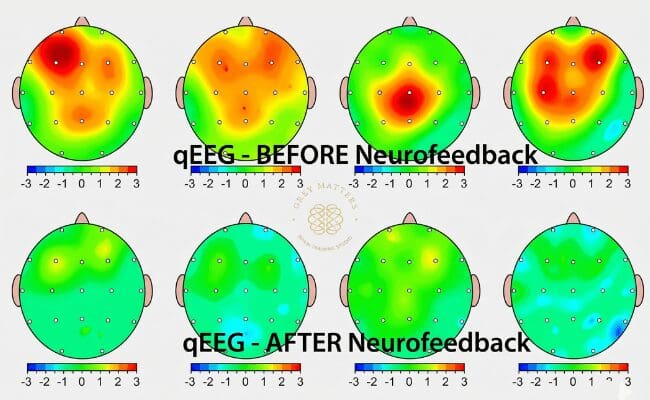
The result is a detailed, color-coded map of your brain’s functional activity: which areas are running too hard, which are underactive, how different regions are communicating with each other, and where the patterns deviate from what would typically be expected for someone your age.
Think of it this way. A standard EEG — the kind used in hospitals — is primarily looking for extreme events like seizures.
A qEEG does something different. It shows us how your brain is functioning during normal resting states — with eyes open and eyes closed — across a wide spectrum of brainwave activity. Not just whether something is wrong, but where your brain’s regulation is working well, and where it isn’t.
What Does It Actually Measure?
Your brain produces different types of electrical waves depending on what it’s doing.
- Delta waves are associated with deep sleep.
- Theta waves appear during drowsiness and certain creative states.
- Alpha waves reflect calm, relaxed wakefulness.
- Beta waves are linked to active thinking, focus, and alertness.
- High beta, when excessive, is associated with anxiety, rumination, and hyperarousal.
Using 19 sensors called channels, the qEEG captures a data-driven image of your brain’s landscape by measuring the amplitude of each brain wave type.
What we’re looking for is dysregulation: patterns that deviate meaningfully from what we’d expect, and that correlate with the challenges a person is experiencing.
For example, a person struggling with attention and focus might show excess theta activity in the frontal lobes — a pattern common in ADHD — combined with underactive beta in the areas responsible for sustained focus. Some clients with anxiety-related symptoms may show patterns such as reduced alpha activity, elevated high-beta, or other signs of hyperarousal. Someone with depression might show a different pattern entirely — often an excess of slow-wave activity in frontal regions, and asymmetry between left and right hemisphere engagement.
Here’s the critical thing: two people can walk into our studio with the exact same diagnosis and have completely different brain maps. The same label doesn’t mean the same brain.
Why That Matters for Your Training
Neurofeedback works by targeting specific brainwave patterns — encouraging frequencies that are underactive, calming ones that are overactive, and improving communication between brain regions.
But if you don’t know which patterns are dysregulated in your brain, you’re choosing a training protocol based on symptoms and assumptions. You’re matching the intervention to the diagnosis rather than the brain.
That’s not how we think about care, and here’s why it falls short.
Imagine two children, both diagnosed with ADHD, both struggling in school.
Child A shows excess theta in the frontal lobes — the slow, drifting pattern that makes it hard to focus and sustain attention. The appropriate intervention is to calm that excess theta and build more active, alert beta in those regions.
Child B, on the other hand, shows no excess theta at all. Her pattern looks more like a brain running on high alert — elevated high-beta, hyperarousal, difficulty settling. If you used the standard ADHD protocol on her, you’d be pushing an already overactivated brain further in the wrong direction. You could make things worse.
Without a brain map, you would never know which of these children you were sitting with. Both present with attention problems. Both carry the same diagnosis. But their brains are telling a completely different story — and they need completely different interventions.
This isn’t hypothetical. We see it everyday. And it’s one of the clearest reasons we built our methodology around the brain map rather than only around the presenting complaint.
What a Brain Map Has Revealed That Surprised Families
We want to share a few patterns we’ve encountered more times than we can count — not to alarm, but to illustrate why looking first is so important.
Anxiety that isn’t anxiety. We’ve had clients come to us labeled with anxiety whose brain maps showed a pattern more consistent with a traumatic brain history, or with sleep disruption driving a hyperaroused nervous system. The presenting symptoms looked the same. The training needed was different.
ADHD patterns that don’t match the diagnosis. Some clients referred for ADHD show brain maps that don’t fit the classic attention-deficit pattern at all. Others have a clinical picture so clearly consistent with the diagnosis that the map actually helps the family understand, for the first time, that their child’s struggles have a neurological basis — not a behavioral one. That clarity matters.
Things we weren’t expecting at all. In some cases, the qEEG may reveal unusual electrical patterns that warrant medical review before neurofeedback begins. When we see something outside the scope of what should be addressed in our studio, we refer the client to the appropriate medical provider before moving forward.
The brain map doesn’t create these findings. It reveals them. And revealing them is how we make decisions we can stand behind.
On the “No Brain Map Needed” Approach — Let’s Be Honest About What That Means
We’re aware that some clinics and biofeedback providers offer neurofeedback programs that skip the brain map entirely. We’re not going to pretend that approach doesn’t exist, and we’re not going to tell you it can never produce any benefit. Some people do experience positive changes with general wellness brain training approaches.
But we think you deserve to understand exactly what you’re getting — and what you’re not getting — so you can make an informed decision.
Some systems that do not require brain mapping are positioned as general wellness tools rather than condition-specific clinical interventions. Under FDA guidance, low-risk general wellness products are intended to support a healthy lifestyle or general wellness.
There is nothing wrong with a general wellness device if that’s what you’re looking for.
But if you are coming to us with a history of PTSD or trauma symptoms, a child who has been struggling in school for years, a head injury or concussion that hasn’t fully resolved, or anxiety symptoms that have resisted other approaches — you are not looking for general wellness optimization. You are looking for something that sees your brain specifically and trains it specifically.
Those are different things. And we think it’s important to say so plainly.
The other argument we hear is that a brain map is just a static snapshot — that the brain changes constantly, and a single map can’t capture that. We agree that the brain is dynamic. What we don’t agree with is the conclusion that a snapshot is therefore worthless. A chest X-ray is a static image, too. We still take it before we make a clinical decision. The map gives us the most complete information available at the start of care — and we take repeat maps throughout the process to see how your brain is changing in response to training.
Which brings us to something we actually love about the brain map: it shows your progress, not just our impressions of it.
A Brain Map Is Also a Measure of Progress
One of the most meaningful moments we witness at Grey Matters is when a client sees their second brain map alongside their first.
The subjective experience of improvement — sleeping better, feeling less anxious, concentrating with less effort, reacting with more steadiness in situations that used to derail them — is powerful. But the objective data is something different. It’s being able to see the change in the brain’s patterns. To point to the map and say: that area of excess activity has normalized. That connectivity that was missing is now present.
We have families who’ve cried at their progress map. Not because we told them things were better — because they could see it.
You can’t have that conversation without a starting point. Without the first map, the second map is just a picture. With both, it’s a story.
What the qEEG Process Actually Looks Like
We know “brain mapping” can sound intimidating, and we want to demystify it.
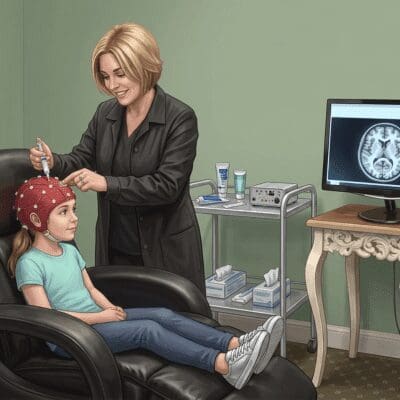
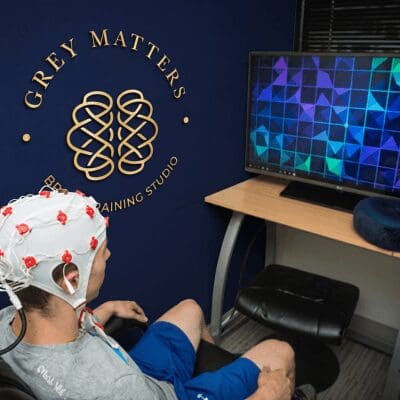
The assessment is completely non-invasive. You’ll sit comfortably while a snug cap with 19 small sensors is placed on your head. The sensors don’t emit anything — they only listen. They’re reading the electrical signals your brain is already producing.
We’ll record your brain activity in two conditions: eyes open and eyes closed. You don’t have to do anything except sit still and relax. No tasks. No tests. No performance required.
The recording takes approximately 20 to 30 minutes. Afterward, our team processes the data and compares it to the normative database — looking at amplitude, connectivity, coherence, and the distribution of activity across regions and frequency bands.
We then schedule a review session where we walk you through your results in plain language. Not jargon. We show you what we see, what it correlates with, and what it suggests about how we should approach your training. We answer every question. You leave understanding your brain better than when you came in — regardless of whether you decide to train with us.
The Question We’d Ask You to Consider
When you’re evaluating where to invest your time, money, and trust for something as important as your brain — or your child’s brain — we think it’s worth asking one clear question:
Does this provider know what my specific brain is doing before they start changing it?
Not what brains with my diagnosis typically do.
Not what the average anxious brain looks like.
What is my brain doing?
What are the specific patterns that need to shift?
What does good progress actually look like for my particular starting point?
At Grey Matters, we can answer those questions because we’ve done the work to find out. The brain map is how we earn the right to train your brain — by understanding it first.
That’s not an upsell. It’s not a barrier to getting started. It’s the foundation of care we’d want for ourselves and our own families. And it’s the standard we’re not willing to drop, regardless of what a lower-cost alternative might offer.
Ready to See Your Brain?
If you’re curious about what your brain is actually doing — or if you’ve been trying to address a challenge and haven’t gotten the answers you need — the brain map is where we start.
It’s a conversation between us and your brain. And in our experience, it always has something important to say.
Frequently Asked Questions About qEEG Brain Map
A qEEG brain map is a detailed look at how your brain is functioning. Unlike an MRI or CT scan, which show brain structure, a qEEG brain map shows brainwave activity and how different areas of the brain are communicating. It helps us see patterns of overactivity, underactivity, and imbalance that may be connected to symptoms like anxiety, focus issues, sleep problems, mood changes, and brain fog.
A qEEG brain map shows how your brain is functioning in real time. It helps identify patterns that may be linked to challenges with attention, emotional regulation, sleep, stress tolerance, processing speed, or mental clarity. It is a functional tool that gives us a clearer picture of what may be happening beneath the surface.
A brain map helps us start with better information. Rather than taking a one-size-fits-all approach, we can look at the patterns in your brain and build a more personalized neurofeedback plan. It also gives us a baseline, so if we repeat the map later, we can compare changes over time instead of relying only on symptoms.
Our Comprehensive Brain Assessment is $597 and includes the qEEG brain map, a written report, and a consultation to review your results and recommendations. If you want to explore both brain and gut health together, our Comprehensive Brain + Gut Assessment is $997 and includes the GI-MAP stool test as well.
Insurance typically does not cover qEEG brain mapping for neurofeedback purposes. However, many clients use HSA, FSA, or HRA funds. Financing options may also be available.
During your brain mapping appointment, you will sit comfortably while we place a soft cap with 19 sensors on your scalp. We use a small amount of gel so the sensors can read your brainwave activity accurately. The recording usually includes time with eyes open and eyes closed, and the full appointment generally takes about 60 to 90 minutes.
Yes. A qEEG brain map is non-invasive and completely passive. Nothing is being sent into your brain. The sensors are only reading the brain’s activity. Most people leave with nothing more than a little gel in their hair.
A qEEG brain map can reveal patterns often associated with concerns like ADHD, anxiety, brain fog, depression, OCD, PTSD, concussion history, learning challenges, sleep issues, and migraines. It is important to know that it is not a medical diagnosis. It is a functional tool that helps us better understand how the brain is operating.
That is still helpful information. If your brain map looks within normal limits, it may mean neurofeedback is not the best first step, or that we should look more closely at other possible contributors such as sleep, hormones, gut health, inflammation, or stress. Our goal is to help you find the right next step, not force a treatment that may not be the best fit.
Your consultation and written report are typically scheduled within 7 to 10 days after your recording. That gives us time to carefully review the data and prepare personalized recommendations.
Yes. We typically work with children starting around age 6, depending on their ability to sit through the recording. If you are unsure whether your child is ready, we are happy to talk it through with you.
Grey Matters Brain Training Studio is located in Carmel, Indiana, just north of Indianapolis. We serve clients from Carmel, Fishers, Westfield, Noblesville, Zionsville, Indianapolis, and surrounding areas.
Not at all. The qEEG assessment is completely non-invasive and painless. A snug cap with 19 small sensors is placed on your head — the sensors only listen to your brain’s electrical activity, they don’t send any signal into your brain. You simply sit back and relax while it records your brain activity for about 20–30 minutes. Most people find it easy and restful.
Because without one, we’d be choosing your training protocol based on your symptoms and diagnosis rather than your actual brain patterns. Two people with identical diagnoses can have completely different brain maps — meaning they need completely different interventions. Applying the same training to different brains is guesswork. The brain map removes the guesswork and lets us design a protocol specific to your brain’s actual starting point. It also screens for neurological patterns that might affect how we approach training safely.
Both statements reflect genuinely different types of services. Some providers use general wellness brain training systems — classified by the FDA as General Wellness Devices — that provide the same feedback to every brain without targeting specific patterns. These can offer general relaxation and nervous system support, but they are not designed or cleared to address specific clinical conditions. At Grey Matters, we use clinical-grade, protocol-based neurofeedback guided by your individual brain map. If you’re seeking something that addresses a specific condition, history, or presenting challenge in your particular brain — rather than general wellness support — a brain map is essential to doing that responsibly.
The recording portion of the qEEG takes approximately 20 to 30 minutes. Allow additional time for setup (placing the sensor cap) and a brief review of next steps. After the recording, our team processes your data and schedules a separate review session to walk you through your results in plain language, answer your questions, and discuss what the map suggests about your training plan.
No — and we want to be clear about this. A qEEG brain map is not a diagnostic tool in the clinical sense. Only a licensed physician or qualified clinician can make a diagnosis. What the brain map does is reveal the functional patterns in your brain’s electrical activity — patterns that often correlate with specific challenges, and that guide how we design your training. In some cases, patterns identified in the map prompt a referral to a physician before training begins. The map informs our approach; it doesn’t replace the diagnostic process.
Yes, and we consider this one of the most important parts of the process. A repeat brain map partway through training gives us objective data on how your brain is responding — not just your subjective report of feeling better (or not), but visible changes in the electrical patterns. It lets us refine your training protocol based on what’s actually shifting and what still needs attention. Many clients find the progress map to be one of the most meaningful moments in their entire experience with us — seeing the change in their own brain, not just being told about it.