
What Causes Brain Fog? The Gut-Brain Connection You Need to Know

This article is educational and is not medical advice or a diagnosis.
You sat down to answer one email. Forty minutes later you’ve reread the same sentence four times, opened three tabs you don’t remember opening, and the word you need is right there — on the tip of your tongue — where it plans to stay for the rest of the afternoon.
If that’s your Tuesday, and your Wednesday, and most of last month, you’ve probably already been told to sleep more, stress less, and try harder.
Here’s the problem: “just try harder” is not a plan. And brain fog is not a character flaw.
Brain fog is a symptom. Symptoms are clues, not flaws. So instead of asking “what’s wrong with me,” the more useful question is the one you came here to ask: what actually causes brain fog? The honest answer is that it’s usually not one thing — it’s a stack of things, and several of them start a lot lower than your neck.
Let’s read the clues.
First, what brain fog actually is (and isn’t)
Brain fog isn’t a medical diagnosis. You won’t find it in a lab result or on a chart. It’s an everyday word for a cluster of very real experiences: slow or fuzzy thinking, trouble concentrating, a memory that drops things, mental fatigue that no amount of coffee touches, and that maddening moment when a common word simply won’t come.
Because it isn’t a formal diagnosis, brain fog gets dismissed — by other people, and often by the person living with it. That dismissal is the part we’d like to retire. Feeling mentally slow when you used to be sharp is information. It usually means something in the system is off: fuel, signal, recovery, or the messages traveling between your body and your brain.
And that last one is where most people are surprised. Because your brain is not floating alone in a jar. It’s wired into the rest of you — your gut, your immune system, your hormones, your sleep — and when any of those get loud, your thinking is often the first thing to get quiet.
The gut-brain connection: why your stomach has a say in your focus
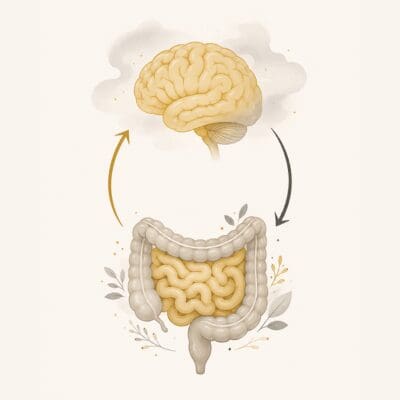
Here’s the mental image worth keeping: the brain and the gut are in a group chat all day.
That chat is real physiology, not a metaphor. Scientists call it the gut-brain axis — a two-way communication network running between your digestive tract and your central nervous system through nerves, hormones, immune signals, and the metabolites your gut bacteria produce. The vagus nerve is one of the main lines in that group chat, carrying signals in both directions between the gut and the brain.
A few things travel on that line that matter for how clearly you think:
- Neurotransmitter raw material. A large share of the body’s serotonin activity is tied to the gut, and gut microbes are involved in producing and regulating chemical messengers that influence mood and, indirectly, focus and energy.
- The microbiome’s mood. Research increasingly links the balance of bacteria in the gut to cognitive and emotional function. Reviews of human and animal studies report that changes in the composition and diversity of gut bacteria are associated with differences in learning, memory, and behavior.
- Inflammation that doesn’t stay put. When the gut lining is irritated or the bacterial balance is disrupted, it can contribute to low-grade inflammation — and inflammation is a recurring character in the brain fog story (more on that next).
An honest caveat, because you deserve one: a lot of this science is still early. Much of the strongest mechanistic evidence comes from animal models, and the human studies are growing but often small. The gut-brain axis is one of the most exciting areas in neuroscience right now — and it’s an area where the confident marketing has outrun the settled proof. So we’ll say it the way the research actually supports it: your gut and your brain clearly influence each other, and that link may be part of why some people feel foggy. It is a pattern worth exploring, not a diagnosis worth assuming.
Inflammation: when your immune system fogs the windshield
Ever notice how a bad cold makes you feel dull and slow, not just sniffly? That’s not your imagination. It’s your immune system talking to your brain.
When the body mounts an inflammatory response, it releases signaling molecules called cytokines. Those cytokines can act on the brain and produce what researchers call “sickness behavior” — low energy, social withdrawal, low mood, and foggy, sluggish thinking. This is a well-described pathway by which the immune system directly influences the brain.
The catch is that inflammation doesn’t only happen during an obvious infection. Chronic, low-grade inflammation — the kind that can travel with poor sleep, ongoing stress, certain diets, gut issues, or a lingering illness — appears to keep some of those same signals switched on in the background. Review of the research have found associations between higher levels of inflammatory markers (like IL-6, TNF-α, and CRP) and poorer cognitive performance.
Think of it like a windshield with a fine mist on it. Nothing is broken. The engine runs. You can still drive. But everything you’re looking at is just a little harder to see — and it’s exhausting to squint at the road all day.
Hormones: the chemical messengers that change the signal
If the gut is the group chat, hormones are the volume knobs. When they drift, the signal changes — and cognition is often the first thing to notice.
The thyroid. Your thyroid sets the body’s metabolic pace. When it runs low (hypothyroidism), fatigue and slowed thinking are classic features — and it’s genuinely common, especially in women. This one matters because it’s measurable with a simple blood test and manageable with your doctor. It’s a textbook example of why guessing is a bad strategy.
Stress hormones. Cortisol is useful in short bursts and corrosive in long ones. Chronically elevated stress hormones are associated with slower processing and weaker memory performance, which is part of why burnout and brain fog so often show up together. If your fog has an anxious, wired-but-tired quality, this may be part of your picture — and it’s an area where support for anxiety symptoms and brain fog can overlap.
Estrogen and the menopause transition. This one is under-discussed and enormously common. Estrogen is active throughout brain regions that support memory and attention, including the hippocampus and prefrontal cortex. As estrogen levels shift and fall during perimenopause and menopause, many women experience new difficulties with verbal memory and focus. A clinical review in Climacteric found these cognitive complaints are real, measurable, and validated by research — and, reassuringly, that they typically fall within a normal range of function and are tied to the hormonal transition rather than to early dementia.
So if you’re a woman in your 40s or 50s wondering whether you’re “losing it” — you are not crazy, and you are not broken. You are noticing a pattern that has a name, and it’s worth talking through with a knowledgeable clinician.
Sleep: the maintenance window your brain can’t skip
You already know sleep matters. What’s easy to underestimate is how fast and how steeply it hits your thinking.
A landmark meta-analysis of short-term sleep loss found that sleep deprivation significantly impairs cognition across multiple domains, with sustained attention taking the biggest hit, followed by working memory. And it doesn’t require an all-nighter. Even partial sleep restriction — the ordinary 5-to-6-hours-a-night pattern that so many adults live in — produces measurable deficits.
Sleep is when the brain does its housekeeping: consolidating memories and clearing out metabolic byproducts that build up during the day. Skimp on that window night after night and the fog isn’t a mystery — it’s the maintenance you didn’t get to.
Here’s the tricky part that traps a lot of people: the causes above feed each other. Poor sleep raises inflammation. Inflammation disrupts the gut. Gut disruption affects mood and sleep. Hormone shifts fragment sleep. Round and round. Which is exactly why brain fog so rarely has a single, tidy answer — and why quality sleep support tends to make everything else easier to untangle.
The other usual suspects (some of them are reversible)
A few more common contributors deserve a spot on the list — partly because they’re frequent, and partly because several are the kind of thing you genuinely don’t want to miss:
- Nutrient gaps. Low vitamin B12 is a well-documented and often reversible cause of cognitive complaints, affecting memory, attention, and executive function; it’s especially common in older adults, people on certain medications, and those eating little or no animal products. Low iron and low vitamin D are also worth checking. The takeaway isn’t “take supplements” — it’s “get tested, because some fog lifts once a real gap is corrected.”
- Blood sugar swings. The energy crashes that follow big sugar-and-refined-carb spikes can bring a very real afternoon fog with them.
- Dehydration. Unglamorous, but the brain is sensitive to even mild fluid loss.
- Medication side effects. Plenty of common medications list mental fatigue or cloudiness among their effects. This is a conversation for your prescriber — never a reason to stop a medication on your own.
Notice the theme: some causes of brain fog are medically identifiable and correctable. That is the single best argument against guessing.
Why brain fog is rarely just one thing
If you’ve read this far hoping to find the cause, here’s the reframe that actually helps: brain fog is usually a stack, not a switch.
Maybe you’re sleeping six hours, running high on stress, three years into a hormonal shift, and quietly low on B12. No single item on that list would flatten you. Together, they fog the windshield. That’s why the person who “tries everything” one thing at a time so often stays stuck — they’re fixing one layer while three others keep the fog rolling in.
This is also why “just try harder” fails as advice. You can’t willpower your way out of a physiological stack. You map it.
When to see a doctor — and why a brain map is not that
Before we talk about mapping, an important boundary. Some cognitive changes need a medical evaluation, not a wellness plan. Please talk to your physician if you notice any of the following:
- Memory or thinking that is steadily getting worse over weeks or months
- A sudden change in thinking, speech, vision, or coordination (seek urgent care)
- Getting lost in familiar places, or trouble with everyday tasks you’ve always managed
- Fog paired with severe headaches, numbness, or weakness
Brain fog usually fluctuates and is tied to identifiable stressors. Progressive, one-directional decline is a different signal and deserves a proper cognitive evaluation. A qEEG brain map is not a substitute for that medical work-up, and it does not diagnose any condition. More on exactly what it is below.
Where brain mapping fits: map the patterns, don’t guess

So where does Grey Matters come in? Not with a promise, and not with a diagnosis. With better information.
Stop guessing. Start mapping. A qEEG brain map records your brain’s electrical activity and shows us the patterns in how it’s working — where activity may be over- or under-active, how regions are communicating, where things look efficient and where they look stuck. Think of it as looking at the receipts. Your brain keeps a record of how it’s been operating; a brain map is one way to read it.
Two things we’re careful to be clear about, because they matter:
- A brain map does not diagnose anything. It does not diagnose ADHD, anxiety, depression, or any other condition. It shows patterns in brain activity that can help guide a personalized training plan — nothing more, and nothing less.
- Neurofeedback is training, not a fix. Where a brain map shows inefficient patterns, neurofeedback is a non-invasive way to help the brain practice more efficient ones — teaching it, over time, to self-regulate. Many clients report improvements in focus, mental stamina, and clarity. Results vary from person to person, and it works best as one piece of a bigger picture.
That “bigger picture” point is the honest one. Neurofeedback works differently from addressing sleep, hormones, gut health, or nutrition — it isn’t a replacement for any of that, and it may complement other care rather than compete with it. If your fog is being driven mostly by low B12 or an untreated thyroid, that belongs with your doctor. If it’s being driven partly by patterns in how your brain is regulating itself, that’s where training can help.
This is also the thinking behind mapping both the brain and the gut. Because the brain and the gut are in that group chat all day, looking at only one side can miss half the conversation. Grey’s Plan pairs neurofeedback brain training with gut testing and clinical oversight, so you’re not left guessing about which layer of the stack is doing the most talking.
The first step
If any of this sounded less like a lecture and more like your Tuesday — the fog, the tip-of-the-tongue words, the six hours of sleep you keep promising to fix — the most useful next move isn’t another article. It’s information about your own patterns.
See where your patterns actually sit. Explore Grey’s Plan → — brain training plus gut testing, so you look at both sides of the group chat.
Prefer to start small? Book a Comprehensive Brain Map → and get a clear picture before you decide anything.
Still learning? Read 10 Signs You’re Living With Brain Fog or see how brain training works.
Symptoms are clues. You don’t have to solve them by trying harder. You can start by looking.
Frequently Asked Questions
The gut and brain communicate constantly through the gut-brain axis — a two-way network of nerves, hormones, immune signals, and bacterial metabolites. Research links the balance of gut bacteria to mood and cognitive function, though much of the science is still early. Gut health may be one contributing factor to brain fog for some people, which is why some choose to look at both.
Gut health may be part of the picture for some people. The gut and brain communicate through the nervous system, immune system, hormones, and microbiome-related pathways. However, gut health is not the only possible cause of brain fog.
Yes. Stress can affect sleep, attention, digestion, energy, and nervous system regulation. For some people, chronic stress can make thinking feel slower, scattered, or disconnected.
There is no single best brain fog remedy because brain fog can have many causes. Sleep, hydration, nutrition, stress support, gut health, movement, medical evaluation, and brain training may all play a role depending on the person.
Start with the basics: hydrate, eat a balanced meal with protein, take a short walk, reduce multitasking, and rest if you are sleep-deprived. If brain fog is persistent, the better question is what is contributing to it.
No. A qEEG brain map shows patterns in your brain’s electrical activity to help guide a personalized training plan. It does not diagnose ADHD, anxiety, depression, or any other condition, and it is not a medical diagnosis of what is causing your brain fog.
Brain fog itself is not usually considered a diagnosis. It is a symptom. If it is persistent, new, worsening, or interfering with life, it is important to talk with a healthcare provider to rule out medical contributors.
Yes. Many people describe brain fog as feeling mentally distant, emotionally flat, or disconnected from daily life. This can happen when the brain is tired, stressed, inflamed, overstimulated, or struggling to regulate efficiently.
Brain fog may feel like slow thinking, forgetfulness, mental fatigue, trouble concentrating, word-finding issues, or feeling disconnected from your surroundings. Some people describe it as feeling like their brain is buffering.
Yes — sleep, hydration, exercise, and addressing underlying inflammation make an enormous difference. Neurofeedback works faster and holds better when these foundations are in place. We often coach clients on these basics because the results are bigger when the brain has what it needs.
This is a concern we hear often. Brain fog tends to fluctuate, is linked to identifiable stressors, and improves when those stressors resolve. Early dementia tends to be more gradual, progressive, and involves memory loss that the person may not be fully aware of. If you are worried, a cognitive evaluation with your physician is the right first step. Neurofeedback is not a substitute for that evaluation.
Sometimes brain fog is tied to stress, poor sleep, or hormones, and sometimes it points to a deeper issue that needs medical evaluation. If symptoms are persistent, worsening, or concerning, it is important to talk with your healthcare provider.
It may. Hormonal shifts can absolutely affect brain function, and neurofeedback can be one helpful piece of support alongside appropriate medical care.
It may. Many people explore neurofeedback when long COVID brain fog lingers and continues to affect focus, clarity, and energy.
Some clients notice subtle improvements early on, while others need more time and repetition. It often builds gradually.
For many people, it may. Where a brain map shows inefficient patterns, neurofeedback is a non-invasive way to help the brain learn to self-regulate, and many clients report clearer thinking and better focus over time. Results vary, and it works best alongside — not instead of — addressing underlying factors like sleep, hormones, and gut health.
Brain fog can be connected to stress, poor sleep, hormone shifts, long COVID, concussion history, inflammation, gut issues, or other health concerns.
Brain fog is a symptom, not a diagnosis. It can feel like slow thinking, poor concentration, forgetfulness, mental fatigue, or difficulty finding words.