
Inattention vs. Distraction: What’s Actually Happening in Your Brain

You sat down to work two hours ago.
In that time you have checked your phone, reorganized one corner of your desk, read half of something unrelated, and returned to the original task three separate times without actually starting it. The task is not hard. You know how to do it. You want it done.
And still, somehow, it is not done.
Most people would call that being distracted. Sometimes that is exactly what it is. But there is a meaningful difference between getting pulled away from a task and not being able to hold onto one in the first place — and understanding which pattern you are dealing with changes what actually helps.
This is not about trying harder. If trying harder worked, you would have solved this years ago.
Distraction: Something Pulled You Away
Distraction is situational. Something external or internal competed for your attention and won, temporarily.
A notification arrives. A coworker starts a conversation nearby. You remember an unrelated errand. The room is too warm, too loud, too quiet. You are hungry. You slept badly.
Normal distraction has a few recognizable features.
Everyone experiences this. It is not a sign that anything is wrong, and the solutions are largely practical.
Inattention: The Pattern Comes With You
Inattention is different. It describes a persistent difficulty with regulating attention — not because something interrupted you, but because sustaining focus on a chosen task is itself effortful in a way it does not appear to be for other people.
The pattern tends to look like this.
Hyperfocus and inattention are not opposites. They are often the same regulation difficulty showing up in two directions.
Why This Distinction Matters

The two patterns respond to different things, which is why mixing them up leads to years of solutions that do not quite work.
If the issue is distraction, the solutions are environmental and behavioral — reduce interruptions, change the setting, batch notifications, protect blocks of time. These work well because they address the actual cause.
If the issue is attention regulation, those same strategies help at the margins and then stop. Not because you implemented them wrong, but because they are addressing interruptions when the difficulty is in directing and sustaining attention in the first place. You can remove every distraction in the room and still find yourself unable to start.
This is also why “just try harder” is not a plan. Effort is not the missing ingredient. Many people with attention regulation difficulties are putting in considerably more effort than people around them and getting less visible output for it — which is its own particular kind of demoralizing.
What’s Happening in the Brain
Attention is not a single thing. It is a set of processes working together — orienting to what matters, sustaining focus, filtering what does not matter, and shifting when the situation changes.
Those processes rely on networks across the brain, and on the brain’s ability to move between states of arousal appropriately. Focus requires a specific middle range: alert enough to engage, settled enough not to bounce.
When attention regulation is difficult, it often has less to do with how much attention someone has and more to do with how reliably the brain reaches and holds that state. A brain running underaroused may drift. A brain running overaroused may be unable to settle onto one thing. Both can look like “can’t focus” from the outside while being quite different underneath.
This is also why attention difficulties frequently travel with other things. Sleep disruption affects arousal regulation. Chronic stress and anxiety affect it. So does the aftermath of a concussion, and so do hormonal shifts. Attention difficulty is a symptom, and symptoms can have more than one contributing pattern.
When Inattention Is Part of Something Else

Persistent attention regulation difficulty shows up alongside a number of things. None of these are diagnoses we can make, and this list is not a checklist — it is context for a conversation with a clinician.
ADHD, inattentive presentation. The version without obvious hyperactivity. The National Institute of Mental Health describes inattention as difficulty paying attention, staying on task, or staying organized, and notes that some people have mainly inattentive symptoms while others experience hyperactivity and impulsivity as well. This presentation appears to have been easier to miss historically, particularly in girls, women, and adults who were never disruptive enough to draw attention. If the pattern has been lifelong and persists across every environment, this is worth discussing with a professional qualified to evaluate.
Anxiety. A brain spending significant resources on threat monitoring has fewer available for sustained focus. Anxiety-related attention difficulty often feels different from the inside — more restless and urgent than drifting.
Sleep disruption. Insufficient or poor-quality sleep affects attention regulation directly. This is one of the first things worth examining, because it is both common and addressable.
Depression. Concentration difficulty is a recognized feature of depression, not an incidental one.
After a concussion or head injury. Attention and processing speed are commonly affected, sometimes well after other symptoms resolve.
Chronic stress or burnout. Prolonged elevated stress affects the same regulatory systems that attention depends on.
Hormonal changes. Many people notice attention shifts around perimenopause, pregnancy, postpartum, or thyroid changes. This overlaps considerably with what we cover in ADHD symptoms in women.
The practical point: “I can’t focus” is a starting observation, not a conclusion. What is driving it matters for what helps.
If the pattern sounds more like mental cloudiness than attention regulation specifically — forgetting why you walked into a room, rereading the same paragraph — brain fog may be a closer fit, and we have written about that separately.
What to Do With This
Four things worth doing before you draw conclusions.
Where Brain Mapping Fits
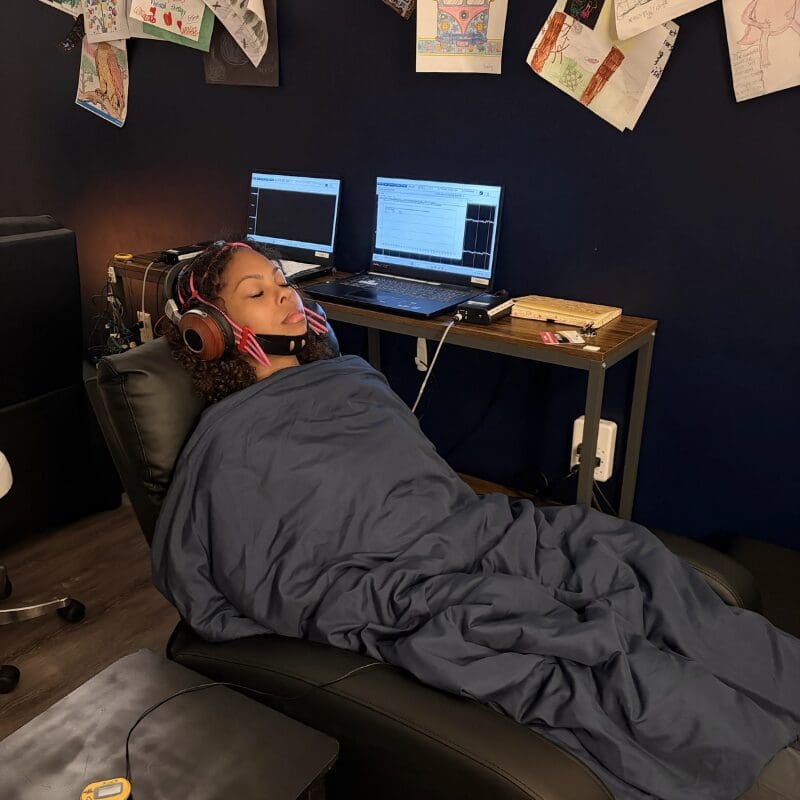
A qEEG Brain Map provides objective information about your brain’s electrical activity — including patterns of overactivation or underactivation, connectivity differences, and arousal patterns that may relate to the challenges you are experiencing.
For someone trying to understand persistent focus difficulty, that information can be useful in a few ways.
A map may help us see patterns related to attention, arousal, sleep, stress, or regulation that can contribute to daily difficulty. It cannot definitively tell us which of those is the cause — no single tool can do that — but it can add information worth considering alongside everything else you know about yourself.
It also gives personalized brain training a starting point. If arousal regulation appears to be part of what is making focus difficult, training is guided by what a particular brain is actually doing rather than by a general protocol.
And for some people it is simply clarifying. Many people who come to us have spent years being told they are lazy or not applying themselves. Measurable patterns of brain activity do not diagnose anything, but they can shift a conversation away from character and toward neurology.
To be clear about what a Brain Map is not: it does not diagnose ADHD, anxiety, depression, or any other condition. Only qualified clinicians can diagnose. A Brain Map is information that may help guide support, nothing more.
Where Brain Training Fits
Neurofeedback is supportive brain training. It is not a treatment or a cure, and it is not a replacement for medical care, therapy, medication, or accommodations.
What it may help support is self-regulation — the brain’s capacity to reach and hold the states that focus depends on. For some people, those regulatory patterns may be part of what makes sustained attention harder than it needs to be.
Research on neurofeedback and attention is growing and some findings are promising, though studies vary in size and protocol and the evidence continues to develop. Responses vary between individuals and we do not make guarantees.
We are also not positioning this against other approaches. Medication helps many people with attention difficulties. Therapy helps many people. Good sleep and reduced stress help nearly everyone. Neurofeedback works differently and may complement those approaches rather than compete with them.
If you want the longer version of how attention difficulty shows up in grown adults specifically, we have written about adult ADHD and what is happening in the brain.
Your Attention Is Not a Character Trait
If you have spent years believing you are lazy, undisciplined, or not trying hard enough, it is worth considering another possibility: that you have been working hard against a regulation pattern nobody identified, with tools designed for a different problem.
Attention regulation is a neurological function. Like any function, it varies between people, and it can be influenced by sleep, stress, hormones, injury, and how a particular brain is wired.
You do not need a diagnosis to start taking your experience seriously. And if you want to understand what your brain is actually doing, we would be glad to talk about whether Brain Mapping would be useful as part of that picture.
Grey Matters does not diagnose ADHD or any other condition and does not replace medical, psychological, or psychiatric evaluation. Brain Mapping and neurofeedback are supportive tools that may help guide self-regulation support within a broader care picture.
Frequently Asked Questions
A qEEG Brain Map provides objective information about brainwave activity, including patterns of overactivation, underactivation, connectivity, and arousal that may relate to the difficulties you are experiencing. It may help identify patterns related to attention, arousal, sleep, stress, or regulation. It cannot definitively identify a single cause, and it does not diagnose ADHD or any other condition — only qualified clinicians can diagnose. It is one source of information that may help guide support.
Neurofeedback is supportive brain training rather than a treatment or cure. It may help support self-regulation — the brain’s capacity to reach and hold the states that sustained focus depends on. Research in this area is growing and some findings are promising, though studies vary in size and protocol and the evidence is still developing. Responses vary between individuals. At Grey Matters, training is guided by a qEEG Brain Map so the approach reflects what a particular brain is actually doing.
Inattentive presentation lacks the visible hyperactivity that has historically prompted referrals. Children who drift quietly rather than disrupt appear less likely to be flagged by teachers, and this pattern seems to have been missed more often in girls and women. Many adults reach their thirties or beyond with a long history of focus difficulty that was attributed to laziness, disorganization, or lack of discipline rather than evaluated.
Yes, and it is common. Hyperfocus and inattention are not opposites — they are often the same attention regulation difficulty showing up in two directions. The underlying challenge is not the amount of attention available but the ability to direct it deliberately. Someone may be unable to start a straightforward task while also losing hours to something genuinely engaging. The difficulty is in choosing where attention goes, not in generating it.
No. Inattention is a symptom; ADHD is a diagnosis. Attention difficulties can be associated with ADHD, but they can also relate to sleep disruption, anxiety, depression, chronic stress, concussion, hormonal changes, or other factors. ADHD inattentive presentation is one possible explanation among several, and only a qualified clinician can evaluate and diagnose. If attention difficulty has been lifelong and persists across environments, a formal evaluation is the appropriate next step.
Focus requires the brain to reach and hold a specific range of arousal — alert enough to engage, settled enough to stay on one thing. When that regulation is difficult, removing external distractions does not solve the problem, because the difficulty is in directing and sustaining attention rather than in filtering interruptions. This pattern can be associated with ADHD, anxiety, sleep disruption, depression, concussion history, chronic stress, or hormonal changes. Persistent focus difficulty in distraction-free environments is worth discussing with a qualified clinician.
Distraction is situational — something external or internal pulled your attention away, and focus returns when that interruption is removed. It tends to be inconsistent across environments and responds well to environmental changes. Inattention describes a persistent difficulty regulating and sustaining attention that follows you across settings, including quiet ones with nothing competing for your focus. Distraction has an identifiable cause you can address; inattention is a pattern that stays consistent regardless of conditions.