
ADHD Symptoms in Women: Why They’re Different (And Often Missed)

You’ve read the ADHD checklists. Fidgeting. Interrupting. Can’t sit still. Talks too much in class.
None of it quite fits.
What fits is this: you re-read the same email four times before sending it. You’ve rebuilt the same color-coded planner a dozen times, and it still falls apart by Thursday. You cry in the car before a meeting you’re completely capable of running. You’ve been called “so smart, if only she’d apply herself” since third grade. You’re exhausted in a way that sleep doesn’t fix.
If you’re a woman who suspects ADHD — or you’re the mother of a daughter who doesn’t look like the ADHD kids in the pamphlets — you’re not imagining things. You’re noticing patterns. And the research backs you up.
ADHD in women doesn’t look like ADHD in the movies. It’s quieter, more internal, and far more likely to be mistaken for anxiety, depression, or “just her personality.” That’s not a small oversight — it’s a documented, decades-long gap in how ADHD has been studied and diagnosed. According to a 2024 CDC report, 61% of women with ADHD weren’t diagnosed until adulthood, compared to 40% of men. Only a quarter of women were diagnosed before age 11, compared to nearly half of men.
This article walks through what ADHD symptoms in women actually look like, why they’re so often missed, and what steps you can take if you’re starting to recognize yourself — or your daughter — in this pattern.
Symptoms are clues, not character flaws. Let’s look at what they’re pointing to.
Take the first step toward clarity → Book a Comprehensive Brain Map
Why ADHD Looks Different in Women
Most of what the public “knows” about ADHD was built from decades of research on hyperactive little boys. That’s not an exaggeration — it’s a well-documented bias in the scientific literature. Girls and women weren’t excluded on purpose, but they were consistently underrepresented in early ADHD studies, which shaped both the diagnostic criteria and the stereotype everyone still carries around.
A landmark 2022 research review in the Journal of Child Psychology and Psychiatry laid out the pattern clearly: girls and women with ADHD tend to show more inattentive symptoms and internalizing problems, while boys and men more often show hyperactive-impulsive symptoms and externalizing behavior. In plain language — boys act out. Girls check out, quietly, and get overlooked because they aren’t disrupting anyone.
Inattentive vs. Hyperactive Presentation
There are three recognized presentations of ADHD: hyperactive-impulsive, inattentive, and combined. Girls and women are more likely to show the inattentive presentation — trouble sustaining focus, difficulty with details, losing track of tasks, forgetfulness, being easily pulled off-course. According to CHADD, this presentation involves failing to attend to detail, difficulty sustaining attention, disorganization, and being easily distracted — symptoms with little visible restlessness. No one’s getting sent to the principal’s office. It just looks like daydreaming, disorganization, or “not trying hard enough.”

Boys, by contrast, are more likely to show combined or hyperactive-impulsive ADHD — the presentation that’s easiest for a teacher or parent to spot, and the one the diagnostic criteria were largely built around.
Hyperactivity Turned Inward
Here’s something that surprises a lot of women: hyperactivity in ADHD doesn’t disappear in women — it just moves inward. According to ADDitude’s overview of ADHD presentation in women and girls, instead of bouncing off the walls, hyperactivity in women often shows up as a racing mind, restlessness that never quite settles, talking quickly or a lot, or feeling like your thoughts are running laps while your body sits still. It’s impulsivity that plays out verbally or emotionally rather than physically — interrupting your own train of thought, blurting things out you didn’t mean to say, or making a decision fast and regretting it later.
None of that trips the usual ADHD alarm bells. It just feels like being “too much” or “too sensitive” — words a lot of women have heard their entire lives.
The Diagnosis Gap, By the Numbers
The scale of the gender gap in ADHD diagnosis is bigger than most people realize.
- In U.S. children ages 5–17, boys are diagnosed with ADHD at nearly double the rate of girls — 14.5% versus 8.0%, according to 2020–2022 CDC data.
- That gap narrows dramatically by adulthood, which tells you something important: it’s not that women “grow into” ADHD later in life. It’s that the same number of women likely had it all along — they just weren’t recognized.
- Diagnoses in adult women have been climbing fast. Epic Research’s analysis of over 3 million patient records found ADHD diagnoses in women aged 23–29 nearly doubled between 2020 and 2022 alone.
- Women are, on average, diagnosed roughly four to five years later than men — even though symptoms tend to start at similar ages in childhood for both, per ADDitude’s ADHD statistics roundup.
This isn’t a story about ADHD becoming more common in women. It’s a story about a lot of women finally being seen.
Mom, you are not crazy. You are noticing patterns.

What “Masking” Actually Looks Like
If there’s one concept that explains why so many capable, high-achieving women go undiagnosed for decades, it’s masking.
Masking is the (often unconscious) effort to hide ADHD traits in order to keep up appearances — rehearsing conversations ahead of time, over-preparing for things other people do casually, building elaborate systems of sticky notes and reminders just to function at a “normal” baseline, or quietly modeling the behavior of more organized peers to blend in.
From the outside, a masking woman often looks like she has it together. She’s the one who’s early to everything, whose desk is spotless, whose calendar is color-coded within an inch of its life. What no one sees is the amount of internal effort it takes to maintain that image — or what happens when the system breaks down: the missed deadline that triggers a spiral of shame, the meltdown in the car after a “perfectly normal” day, the burnout that seems to come out of nowhere.
The 2022 JCPP research review specifically identified masking and compensatory strategies as more common in girls and women with ADHD than in boys and men, which is part of why clinicians so often miss it. A woman who “seems fine” rarely prompts anyone — including herself — to consider ADHD as the explanation.
The cost of all that masking is real: chronic exhaustion, anxiety, and a slow erosion of the sense that you know who you actually are underneath the coping mechanisms.
Symptoms Often Mistaken for Anxiety, Depression, or “Just Her Personality”
This is the part that trips up even good clinicians. Many of the everyday symptoms of ADHD in women get filed under a completely different label — usually anxiety or depression — because the surface-level presentation overlaps so much.
Chronic overwhelm. Not “stressed about a deadline” overwhelm — the kind where everyday tasks (replying to a text, making a phone call, deciding what to make for dinner) feel disproportionately heavy, because your brain is quietly working overtime just to organize and prioritize.
Perfectionism as compensation. A lot of women with undiagnosed ADHD become perfectionists not because they’re wired to be flawless, but because perfectionism is the compensatory system that’s kept things from falling apart. If everything has to be exactly right, there’s less room for the disorganization to show.
Emotional dysregulation. Big emotional reactions to small triggers — frustration that escalates fast, tears that show up at inconvenient moments, irritability that feels disproportionate to what’s actually happening. This isn’t officially part of the diagnostic checklist for ADHD, but researchers increasingly recognize it as one of the most impairing parts of the condition — arguably more disruptive to daily life than inattention or hyperactivity themselves.
Rejection Sensitive Dysphoria (RSD). This isn’t a formal diagnosis, but according to the Cleveland Clinic, it’s a pattern many clinicians and people with ADHD describe: an intense, almost physical wave of emotional pain in response to perceived criticism or rejection — even mild or imagined rejection. In women, this often plays out as people-pleasing, conflict avoidance, over-apologizing, or replaying a conversation for days trying to figure out what you did wrong.
Chronic self-doubt. Years of being told you’re “not living up to your potential” tend to produce a quiet, persistent narrative that something is wrong with your character — when the real explanation was a brain that processes attention and organization differently.
Because these symptoms overlap so heavily with anxiety and depression, a lot of women get treated for years for a mood disorder that’s actually a downstream effect of unmanaged ADHD. One genetic study published via the National Institutes of Health found that ADHD risk may be more likely to show up as an anxiety or depression diagnosis in women than in men — meaning the underlying wiring was there, just labeled differently.
Ready to understand what’s actually going on? See if neurofeedback is right for you →
Hormones and ADHD: Why Symptoms Shift Throughout Life
Here’s a piece of the puzzle that’s rarely discussed in mainstream ADHD content: hormones and ADHD symptoms are connected, and that connection is unique to women.
Estrogen interacts with dopamine, the same brain chemical central to attention and motivation. When estrogen drops — in the days before a menstrual period, postpartum, or during perimenopause — many women notice their ADHD symptoms intensify: more forgetfulness, more trouble focusing, more emotional reactivity. Some women also report that ADHD medication feels less effective during the second half of their cycle.
This is still an emerging area of research, and it deserves more study than it’s gotten. But some early findings are notable: cohort research has found women with ADHD reporting significantly more severe perimenopausal symptoms, and reporting them starting earlier, than women without ADHD.
It’s also worth naming the overlap directly: brain fog, memory lapses, and irritability during perimenopause can look a lot like ADHD symptoms — which means the two are sometimes confused for each other, and sometimes compounding each other at the exact same time of life. (If brain fog specifically is what you’re dealing with, we’ve written a full guide on what causes brain fog and how to get relief from it.)
If you’ve noticed your focus, memory, or emotional regulation shifting with your cycle, pregnancy, or menopause, that’s not “just hormones” dismissively — it’s a real, biologically-grounded pattern worth paying attention to.
Why the Delay Happens
Put all of this together and the diagnostic delay makes complete sense:
- Subtler symptoms don’t trigger a teacher referral or a parent’s concern the way disruptive behavior does.
- Masking hides the internal effort it takes to function, especially in high-achieving women.
- Compensatory intelligence — many undiagnosed women are smart enough to build workarounds that hold together until life gets more demanding.
- Misdiagnosis as anxiety or depression treats the symptom, not the root pattern.
- Life transitions — a new job, a new baby, a divorce, perimenopause — often overwhelm the coping systems that have been holding everything together for years, which is when a lot of women finally seek answers.
- A common trigger: many women are only evaluated for ADHD after their own child is diagnosed, and they start recognizing the exact same patterns in themselves.
None of this is a character flaw. It’s a systemic blind spot — and the data confirms it. If this pattern sounds like it applies more to your day-to-day focus struggles as an adult than a formal diagnosis question, our article on adult ADHD and why it feels so hard to focus is a good next read.
What This Means for You
If any of this sounds familiar — for yourself or for your daughter — the goal isn’t to self-diagnose off a blog post. The goal is to stop dismissing the pattern and start understanding it.
That’s where brain mapping comes in.
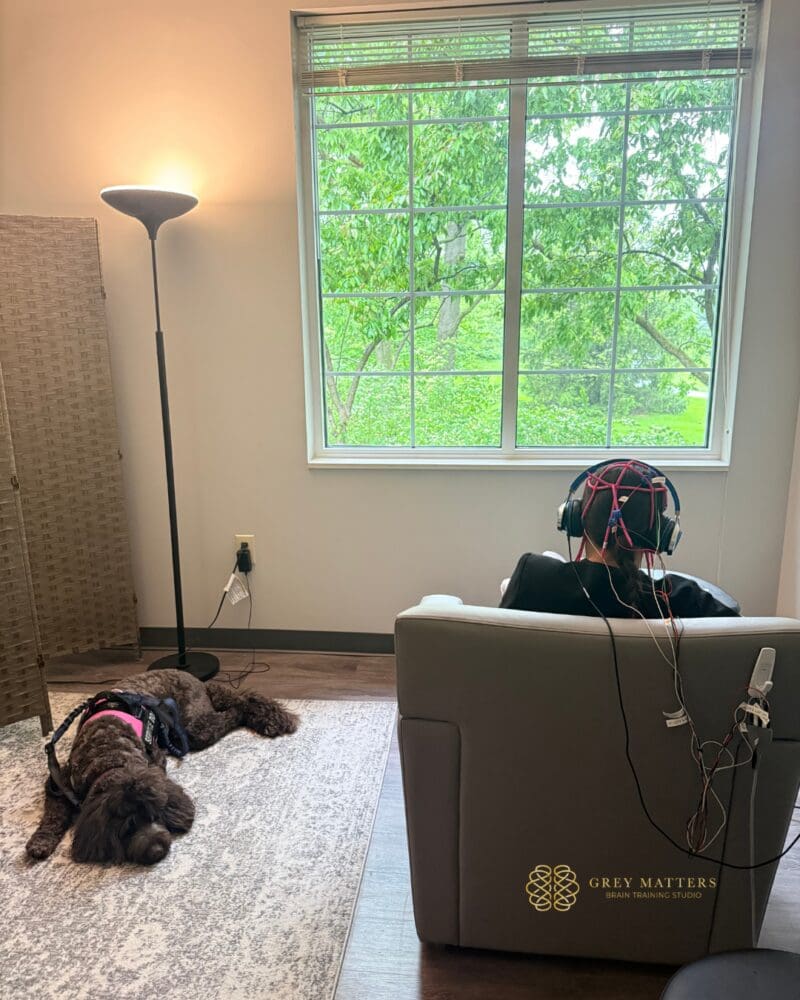
A Comprehensive Brain Map uses qEEG (quantitative electroencephalography) to look at your brain’s activity patterns — not to diagnose ADHD, anxiety, or any other condition, but to help you and our team understand what’s actually happening and guide a personalized approach to neurofeedback training. Brain mapping doesn’t replace a formal medical evaluation. Think of it as a different kind of data — objective information about your brain’s patterns, gathered specifically for you. You can read more about what a qEEG brain map actually involves here, or see what to expect at your first brain mapping appointment.
For a lot of women, especially those who’ve been told for years that their struggles were “just stress” or “just anxiety,” that objective data can be validating in a way that a checklist never was.
The brain has receipts.
A Note on Neurofeedback and Brain Training
We want to be honest with you about where the research actually stands, not oversell it.
Neurofeedback is a form of brain training that uses real-time feedback about brain activity to support the brain’s ability to self-regulate. It’s an active area of research, and some studies — particularly those using standard protocols like theta/beta ratio training — have shown modest positive signals for outcomes like processing speed. At the same time, the most rigorous recent meta-analysis — a 2024/2025 systematic review in JAMA Psychiatry covering 38 clinical trials and nearly 2,500 participants — found that once studies were properly blinded, neurofeedback did not show a clinically meaningful reduction in ADHD symptoms at the group level. An earlier 2016 meta-analysis in JAACAP found a similar pattern: effects that looked meaningful in less-blinded ratings largely disappeared under stricter, blinded, controlled conditions.
We’re telling you this because we’d rather be the clinic that’s straight with you than the one that oversells a “cure.” Neurofeedback is not a treatment, cure, or diagnostic tool for ADHD. What many clients report is support for self-regulation — training the brain’s patterns rather than managing symptoms with willpower alone. It’s not a replacement for therapy, medication, or medical care, and we’re not anti-medication. We’re pro-information. We think you deserve to understand your own brain, make an informed decision, and pursue whatever combination of support actually works for your life. (You can browse the studies we reference across our site on our Research Articles page.)
See if brain mapping is right for you
Frequently Asked Questions
No. Neurofeedback is not a treatment or cure for ADHD. It’s a form of brain training that may help support self-regulation. Research on its effectiveness is ongoing and mixed, and it should be considered a complementary approach rather than a replacement for medical care.
No. A qEEG brain map shows patterns in brain activity and helps guide a personalized approach to neurofeedback. It is not a diagnostic tool for ADHD or any other condition — a diagnosis requires evaluation by a licensed medical or mental health professional.
Many women report that ADHD symptoms shift with hormonal changes — worsening in the days before a period, during postpartum, and during perimenopause, when estrogen drops. This is an area of ongoing research
The underlying condition is the same, but the presentation often differs. Women more commonly show inattentive symptoms and internalized hyperactivity (racing thoughts, restlessness) rather than the outward hyperactivity more often seen in boys and men.
Yes — and it happens more often than people realize. CDC data shows the majority of women with ADHD are diagnosed as adults, not children. Late diagnosis is common, especially for women with the inattentive presentation.
The First Step Is Understanding the Pattern
If you’ve spent years wondering why you have to work twice as hard to seem half as put-together as everyone else — or why your daughter is brilliant in conversation but falls apart over homework — you’re not broken, and you’re not alone. You’re describing a well-documented pattern that research is only now catching up to.
Because “just try harder” was never a plan.
Book your Comprehensive Brain Map today and start with real data about your own brain →
This educational article does not constitute medical advice, diagnosis, or treatment. Grey Matters Brain Training Studio does not diagnose, treat, or cure ADHD or any medical condition; instead, we offer brain training aimed at mitigating ADHD symptoms. If you believe you or your child may have ADHD, please consult a qualified physician or mental health specialist for a formal evaluation.