Hidden, Suppressed, & Repressed Memories Can Have A Powerful Influence
Read Time:
9.1 minutes
Categories:
Share This:

Did you know that your brain stores memories, which you may not even be aware of, that continuously impact your mental health, behavior, and life?
Significant life events — both good and bad — get cemented in your memory. Glimpses of life’s happy little moments can bring back feelings of joy. Other not-so-good memories evoke pain, stress, or difficult emotions. In the latter case, you might make a conscious effort to avoid thinking about the uncomfortable memories — but you’re still aware of them. These are all examples of explicit memories, which you can consciously recall — even if you would rather not.
Your brain also files away implicit and repressed memories below your conscious awareness and while you can’t actively retrieve or recall these memories, they can still significantly impact your life.
All types of memories influence your mental health, behavior, perception of the world, response to new situations, and interaction with others. Read on to find out how.
Explicit Memories
Explicit memories are memories that involve conscious thought, can be recalled, and are declarative. Explicit memories include factual and general knowledge about things. Examples of explicit memory include:
- Items on a list,
- Important dates,
- Names, addresses, and phone numbers,
- Learning things for school or work, and
- Remembering an important life event.
There are two types of explicit memory:
- Episodic memory: the recall of life events and autobiographical knowledge, and
- Semantic memory: all non-biographical explicit memory.
Implicit Memories
Unlike an explicit memory, an implicit memory doesn’t involve the experience of recalling and can be described as retention without remembering. Implicit memory can be behavioral, emotional, perceptual, or somatosensory, and is often felt in your body. A good example of implicit memory is hopping on a bike and remembering how to ride. An explicit memory would be the recollection of someone teaching you how to ride. Alzheimer’s patients can remember how to read, write, walk, and talk even after they can no longer recognize loved ones because of implicit memory.
Marsha Lucas, PhD, neuropsychologist, and psychotherapist, calls implicit memories the “unthought known” and labels them the “unconscious effects of your past experiences.” She writes:
“These memories got quickly and permanently stored, even though you don’t have conscious awareness of them as memories — they’re just kind of “in there,” informing and influencing you without any kind of time stamp, and without your being aware of their influence.”
Implicit memories can be invisible forces in your life, impacting you in powerful ways. Because they are unconscious, bodily memories, when they are triggered in the present, you don’t realize that your reactions are coming from the past. Instead, you feel the emotions and bodily sensations from the memory when triggered by present circumstances.
Traumatic Memories Can Be Explicit and Implicit
Traumatic memories are often implicit because trauma causes the brain to flood with cortisol, a stress hormone, which shuts down the part of the brain that processes memories to make them explicit. Implicit memories are more encoded in the nervous system and body. Research has suggested that implicit memory plays a role in panic disorder and post-traumatic stress disorder (PTSD).
Trauma can also impact explicit episodic memory because it can prevent information from various parts of the brain from combining to make a semantic memory. The unprocessed remnants of trauma stored in memory can cause health issues throughout a person’s life.
What Are Repressed and Suppressed Memories?
Repressed memory is a scientifically debated psychiatric phenomenon where a person cannot recall autobiographical memories, usually of a traumatic or stressful nature. The concept of repressed memories is an ongoing topic of debate among psychologists and scientists and is still being researched.
It’s suggested that repressed memories are pushed out of a person’s conscious awareness as a defense mechanism to protect the person from emotional distress. These memories are stored in the unconscious mind and can resurface later in life, often through therapy. While some individuals and therapists do believe in the validity of repressed memories, there is a fair amount of skepticism within the scientific and psychological communities.
Unlike implicit memories, repressed memories were once conscious but have been moved out of conscious awareness. The belief is that these memories are still present in the unconscious mind but are not accessible to be recalled.
Suppression is entirely voluntary, and suppressed memories are explicit. It’s the conscious effort to forget or not think about painful or unwanted thoughts or memories and is typically applied to temporary thoughts and emotions, such as anxiety or anger. Suppression can happen automatically in people who habitually suppress thoughts, emotions, and memories. It can be an effective coping mechanism in the short term, but eventually, suppression increases anxiety and depression when the suppressed items aren’t dealt with.
Your Memories Affect Your Brain and Mental Health
I’m sure you’ve heard a quote similar to, “Memories make us who we are.” Well, there’s a lot of truth to that statement. Memory has a significant impact on a person’s behavior and mental health and influences how they perceive the world, respond to new situations, and interact in their relationships. Memory is also at the core of many psychiatric and neurodegenerative disorders. When people lose their memories, they can lose their identity and how they process the world.
Your memories show up in the present as behaviors, feelings, and mental health issues. For example, because of implicit memories, you may feel a constant buzz of anxiety or see danger in completely non-threatening situations and not really know why. Because of an explicit memory of an unpleasant experience with a dog, you may fear dogs now or because of a suppressed memory of your sibling’s sickness, you procrastinate visiting a close friend who has cancer.

PTSD and Memory: When the Past Keeps Showing Up in the Present
What PTSD Does to the Brain’s Filing System
Most people think of PTSD as an emotional problem. But what is actually happening inside the brain is a memory problem — specifically, a filing problem.
When a traumatic event occurs, the brain’s stress response floods the system with cortisol and adrenaline. This shuts down the hippocampus, the part of the brain responsible for processing experiences into organized, time-stamped memories. Without that processing step, the trauma does not get filed away as something that happened in the past. Instead, fragments of it — sounds, smells, physical sensations, emotional states — get stored as raw, unprocessed data in the body and nervous system.
That is why PTSD does not feel like a memory. It feels like now.
A car backfiring. A specific cologne. A tone of voice. These sensory triggers can pull the nervous system back into a full stress response because, as far as the brain is concerned, the threat never ended. The memory was never completed.
The Brain Keeps Score — Even When You Don’t Know It’s Keeping Score
Research suggests that in PTSD, the amygdala — the brain’s alarm system — may become overactive while the prefrontal cortex, which provides context and rational thought, may become underactive. This imbalance can make it difficult to distinguish between real danger and a memory of danger.
This may show up as:
- Hypervigilance in situations that feel objectively safe
- Emotional reactions that seem disproportionate and hard to explain
- Physical tension, sleep disruption, or a nervous system that never fully settles
- Difficulty trusting memory — wondering what is real, what is distorted, or what is missing entirely
If any of this sounds familiar, your brain is not broken. It adapted. It learned to survive. And because of neuroplasticity — the brain’s ability to reorganize and rewire — that same capacity for change is still available to you.
Understanding Your Brain’s Patterns Is the First Step
Before any kind of brain training can be truly personalized, it helps to understand what your brain is actually doing — not what you assume it is doing based on symptoms alone.
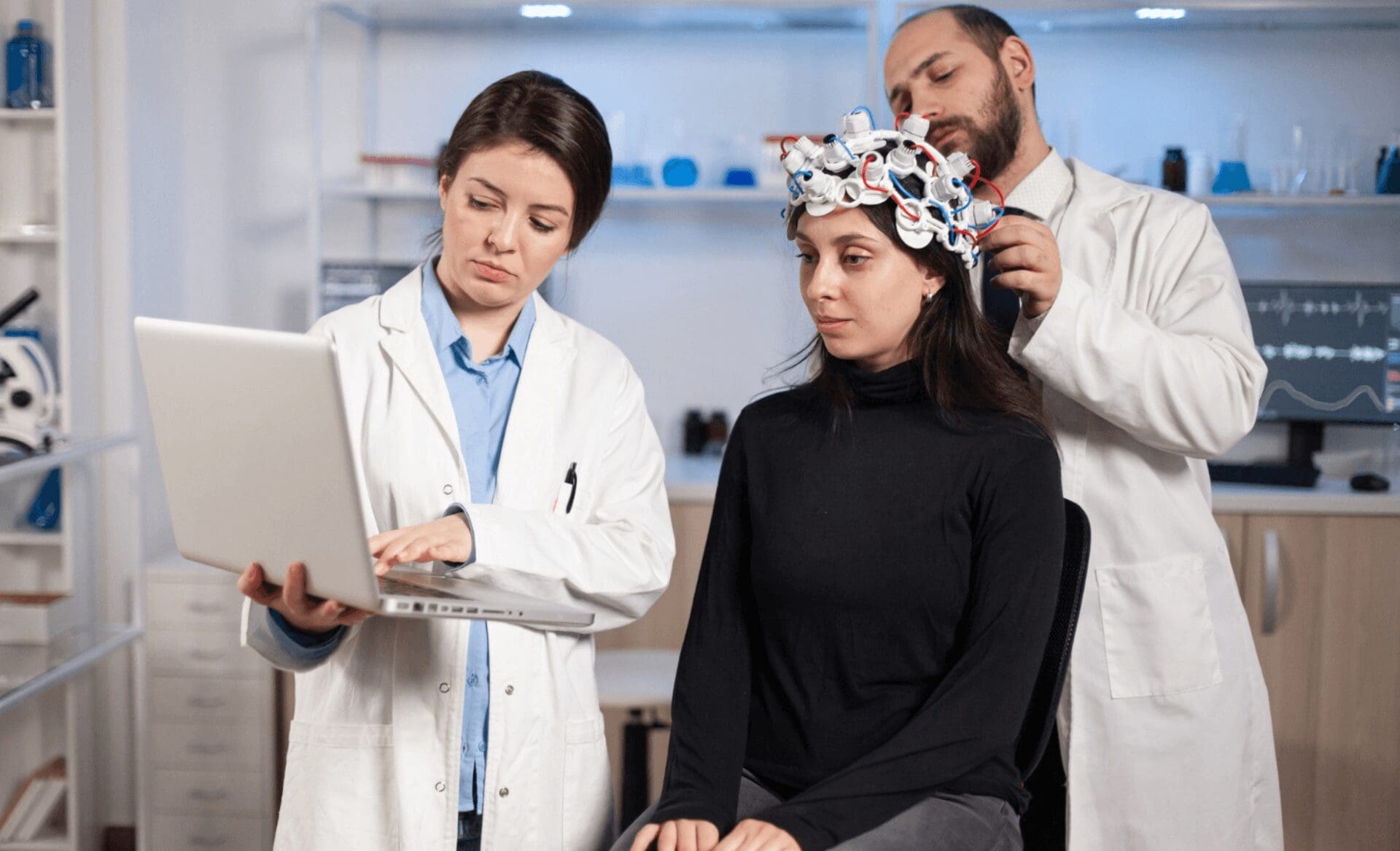
A Comprehensive Brain Map at Grey Matters uses qEEG technology to capture a detailed picture of your brain’s electrical activity patterns. It does not diagnose PTSD. What it does is show us where the brain may be working harder than it needs to, where certain frequencies may be dysregulated, and what patterns may be connected to the symptoms you are experiencing.
Many clients describe their Brain Map session as the first time they felt seen — not just listened to, but shown actual evidence of what has been happening inside their brain.
That information becomes the foundation for a personalized brain training plan designed to help your brain learn to self-regulate — which may help mitigate symptoms like hypervigilance, emotional reactivity, and sleep disruption that so often accompany PTSD.
Your memories shaped your brain. That does not mean they get to define it forever.
Ready to understand what your brain is doing — not just what it’s feeling? Schedule your Brain Map at Grey Matters in Carmel, Indiana, and start with a clear picture.
Memories have such a profound influence on us because they literally shape our brains through something called neuroplasticity, the ability of our brains to change both form and function based on experiences, behaviors, emotions, and even thoughts. For example, the more you recall a memory, the more you reinforce it in your brain. Neuroplasticity is what allows traumatic events and memories to change the way your brain operates. It also allows the brain to change again and heal.

You “see” memories through your mindset at the time you recall them.
Every time you recall a memory, your brain filters it and changes it slightly according to your brain state at the time of remembering. Your brain adds a subjective tint to your memories by factoring in what you believe and feel at the time of recollection. So, if you are depressed, each time you call up a memory, it changes and grows more emotionally charged and depressing.
Conclusion
Your memories make you who you are and guide your behavior, relationships, mental health, and life. But please know that nothing in memory is “written in stone.” Memory is an active and ongoing process. In his book, Proust Was a Neuroscientist, Jonah Lehrer writes, “A memory is only as real as the last time you remembered it.”
Your memories can change, and your brain can change.
I want you to know that if you are dealing with PTSD, CPTSD, trauma, anxiety, depression, ADHD, brain fog, brain injury, autism, apraxia, migraines, or any other mental health or brain issue, your brain can change in ways that can alleviate problematic symptoms. At Grey Matters Brain Training Studio in Carmel, we are passionate about helping people live their best lives, including optimizing their brain’s health and function. Give us a call at (317) 215-7208 or send us a message today to find out how we can help you.
Photo Credits:
Second Image Photo by Caleb George on Unsplash