Starting Neurofeedback: What to Expect at Your First Brain Mapping Appointment

If you’ve been thinking about neurofeedback…
you might be wondering:
“What actually happens when we start?”
Do you just book a session?
Sit down?
Hope it works?
If you’ve had those questions—you’re not alone.
Most parents and adults come in feeling curious, but also a little unsure about what the first step looks like.
And that uncertainty makes sense.
Because here’s the truth:
Effective neurofeedback doesn’t start with training. It starts with understanding.
At Grey Matters, that understanding begins with something called a Brain Map.
And once you know what to expect, the process becomes much clearer—and much more reassuring.
Why You Don’t Start With a Neurofeedback Session
It’s easy to assume neurofeedback works like other appointments.
You show up, start sessions, and see what happens.
But the brain doesn’t work that way.
Each person’s brain has its own patterns—how it regulates attention, processes stress, and shifts between calm and alert states.
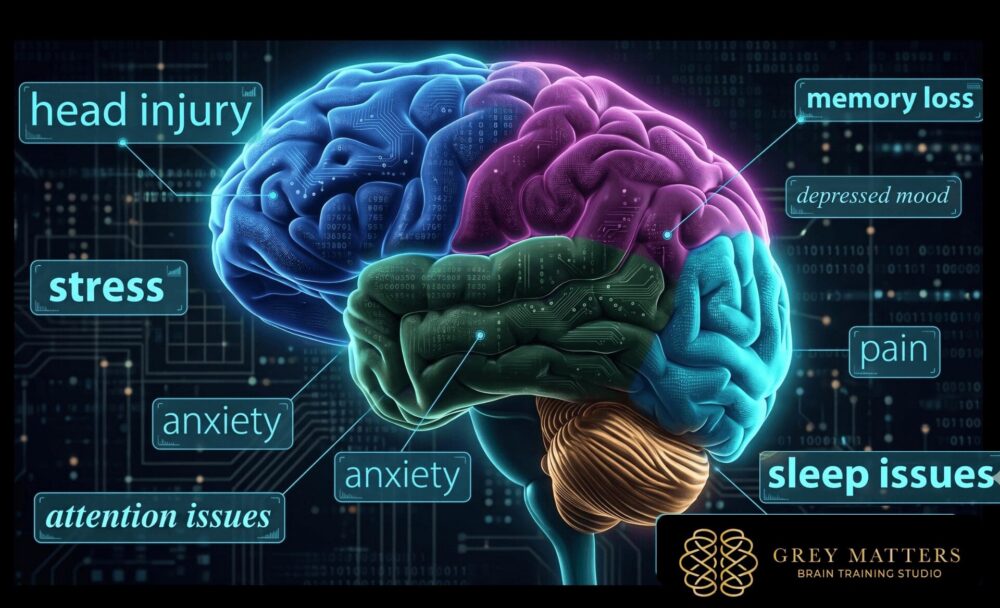
Research shows that brainwave patterns are closely tied to symptoms like anxiety, ADHD, sleep disruption, and emotional regulation challenges.
That means starting without understanding those patterns can lead to a more generalized approach.
And when it comes to the brain, guessing isn’t the goal.
Clarity is.

Step 1: The Brain Map — Understanding What Your Brain Needs
This is where everything begins.
Before any training starts, we take a closer look at how your brain is functioning.
What Is a Brain Map?
A qEEG Brain Map is a non-invasive way to measure your brain’s activity.
It helps identify patterns that may be connected to what you or your child are experiencing, such as:
- Difficulty focusing
- Anxiety or emotional ups and downs
- Sleep challenges
- Brain fog or mental fatigue
Your brain is always communicating. A Brain Map simply helps us listen more clearly.
What Happens During the Appointment?
The process is simple and designed to feel comfortable.
Small sensors are placed on the scalp to record brain activity. They don’t send anything into the brain—they only read what’s already happening.
You’ll sit quietly while the data is collected. Some parts may involve resting with eyes open or closed.
Most people describe it as:
- Calm
- Easy
- Non-invasive
There’s nothing you need to “do right.”
Just show up as you are.
What the Brain Map Helps Us See
Once the data is collected, we begin to look at patterns.
These patterns can help explain why certain challenges are happening—not as a label, but as insight.
For example:
- Areas of overactivity may be linked to anxiety or restlessness
- Underactivity may relate to focus or motivation challenges
- Irregular patterns may affect sleep or emotional regulation
For many families, this step feels validating.
It’s not “something is wrong with you.”
It’s your brain is working in a certain way—and now we can understand it.
If you’ve been searching for answers, this is often the most important first step. You can schedule a Brain Map with Grey Matters to start with clarity instead of guesswork.
Step 2: Turning Insight Into a Personalized Plan
Once we understand what your brain is doing, the next step is creating a plan.
This is where things begin to feel more grounded and hopeful.
We walk through the results together in simple, clear language—no overwhelming terminology.
You’ll learn:
- What patterns showed up
- How those patterns connect to symptoms
- What your brain may need support with
From there, we build a personalized neurofeedback plan.
Because effective training isn’t about doing more.
It’s about doing what your brain actually needs.
Step 3: Your First Neurofeedback Session
After your plan is in place, you begin training.
This is where the brain starts learning new patterns.
What Happens During a Session?
Sensors are placed on the scalp again, this time to monitor your brain in real time.
You may watch a screen or listen to sounds while your brain receives feedback.
As your brain shifts toward healthier patterns, the feedback adjusts.
This process helps your brain learn self-regulation naturally.
Research has shown that neurofeedback can support improvements in attention, emotional regulation, and sleep by reinforcing more balanced brain activity.
What Does It Feel Like?
This is one of the most common questions.
Neurofeedback is:
- Passive
- Gentle
- Non-invasive
You don’t have to try to make anything happen.
Many people describe sessions as relaxing—a chance for the brain to recalibrate without effort.
What Changes Can You Expect Early On?
Everyone’s experience is different.
Some people notice early shifts like:
- Feeling a bit calmer
- Improved sleep
- Slightly better focus
Others may not notice changes right away—and that’s okay.
The brain is learning over time.
Just like building a new habit, consistency matters more than speed.
Why the Brain Map Makes Neurofeedback More Effective
Here’s where everything connects.
Neurofeedback works by helping the brain regulate itself.
But if we don’t understand what the brain is doing first, that process becomes less precise.
Starting with a Brain Map allows us to:
- Target the right areas
- Avoid trial-and-error
- Support more consistent progress
In other words:
We’re not just training the brain—we’re training it with intention.
Who Is This Process For?
Neurofeedback may be helpful for individuals experiencing:

- Attention or focus challenges (ADHD)
- Anxiety or emotional overwhelm
- Sleep difficulties
- Brain fog or mental fatigue
- Mood regulation challenges
You don’t need to have a perfect understanding of what’s going on.
You just need a place to begin.
When You’re Ready to Take the First Step
If you’ve been trying different approaches…
or feeling like something is off but you can’t quite explain why…
or simply want to understand your brain better…
This is where many families start.
Not sure if neurofeedback is the right fit? You can contact Grey Matters to talk through your questions and get guidance before scheduling.
Start With Clarity, Not Guesswork
At Grey Matters, we don’t begin with assumptions.
We begin with understanding.
A Brain Map gives you insight into how your brain is functioning—and what it may need to feel more balanced, focused, and regulated.
Schedule your Brain Map with Grey Matters and take the first step toward real answers and personalized support.
Your brain isn’t broken.
Sometimes, it just needs the right information—and the right support—to function the way it was meant to.
*Please note: Equipment shown may vary at Grey Matters.
Frequently Asked Questions About Starting Neurofeedback
Some people may notice dizziness or vertigo-like feelings, although this is less common. If you experience dizziness, especially if it is intense, persistent, or unusual for you, tell your neurofeedback provider and speak with your healthcare provider.
Do not ignore discomfort. If you feel tired, dizzy, emotional, wired, or off after a session, tell your provider. Sometimes the protocol, session length, or training frequency can be adjusted. For severe or persistent symptoms, contact your healthcare provider.
Neurofeedback is non-invasive and generally well tolerated. Sensors read the brain’s activity; they do not send electricity into the brain. However, anyone with medical concerns, neurological conditions, seizures, significant vertigo, recent concussion, or medication changes should talk with their healthcare provider before beginning.
Neurofeedback is a type of biofeedback focused on brain activity. Biofeedback is generally non-invasive, but people can respond differently depending on their health history and the type of training. With neurofeedback, temporary effects may include fatigue, headache, dizziness, sleep changes, or emotional sensitivity.
Some people may experience mild headache or fatigue after neurofeedback. This may happen as the brain responds to training, but headache and fatigue can also have other causes, including sleep, hydration, stress, blood sugar, migraines, or medication changes.
Some of the temporary effects people may report after neurofeedback include fatigue, mild headache, dizziness, sleep changes, emotional sensitivity, or feeling a little off after a session. These effects are usually short-lived, but they should always be shared with your provider.
We use Brainmaster amplifiers and BrainAvatar software.
We do not accept insurance; however, we offer a variety of payment options.
We accept:
- Cash, checks, all major credit cards, and Apple Pay
- Health Savings Account (HSA) and Flexible Spending Account (FSA) and HRA Health Reimbursement
- Financing options are available through First Financial Bank
- Advanced Care Credit
- Vagaro Pay Later
- Monthly Payment Plans
Think about the cost of therapy, medications, dissatisfaction with life, lost work hours, and the hope to feel better. It’s worth it. Come on in, we got you.
Grey Matters Brain Training Studio offers simple training packages. Choose from a set number of sessions or our most popular plan, Grey’s Plan 4-Month Unlimited Membership which costs $5,997. Family packages are also available.
To get started, come on in for a Brain Health Assessment, with a qEEG brain map designed to help you take the first step toward a healthier mind and improved quality of life. With our expert guidance and state-of-the-art neurofeedback technology, you can experience positive changes in your mental well-being.
Sleep hygiene, a healthy diet, reduced screen time, exercise, and stress management, among many other factors, help you improve not only your brain but also your overall well-being.
There are no long-term negative effects.
Just like taking your temperature with a thermometer does not deliver anything to your body, a qEEG brain map or a qEEG-guided training session does not deliver anything to your brain – it only reads your brain’s electrical activity. The auditory feedback you hear encourages your brain to “exercise.” So, similar to the variety of feelings after a good workout at the gym, some people experience symptoms such as being more tired or more wired, and few will develop a slight headache after a session. These symptoms go away within hours and are not long-lasting.
Our Brain Coaches are here to assess your training progress, discuss any symptoms you may experience, and provide educated feedback to you during your journey.
Consistency is key. The brain requires a minimum of 2 sessions per week to learn and retain new patterns. An average of 35 sessions is needed for the brain to make permanent neuroplastic changes. Remember, your brain is learning, and learning takes time and repetition. If you have multiple diagnoses or are on psychological medications, more sessions may be required for your desired results.
In a neurofeedback session, qEEG sensors are placed on your scalp, recording your brainwaves and sending the information to a computer in real-time. The computer, through auditory or sound feedback, teaches your brain to perform at optimal levels by a method called operant conditioning, which harnesses your brain’s reward system.
All learning is at a subconscious level. You don’t actually have to “do” anything. With consistent repetition through auditory feedback, the brain learns to self-regulate and makes physiological changes to perform more optimally and will continue to make the adjustments after the initial training. Because it’s a learning process, the results of neurofeedback occur gradually over time.
During a 35 to 45-minute session, you sit comfortably in a chair. You can have a footstool, blanket, and eye mask for relaxation. You are given headphones to listen to the training sounds and can either watch scenic images, read, journal, or kick back and relax. For the younger ones, they can color, draw, read, do homework, or play with Legos.
Yes.
Some clients are able to decrease their medication over time with their prescriber. Grey Matters does not make any medication adjustments.
Neurofeedback is a superior solution because it doesn’t just ease the symptoms. It addresses and changes what is causing the symptoms or problems at the source in your brain. Your brain learns how to function differently in a way that relieves problematic symptoms or behaviors.
Neurofeedback training has many scientifically documented benefits both for the brain and body, including stress reduction, improved sleep, better focus and memory, heightened mental clarity, more emotional and behavioral regulation, enhanced cognitive performance, and more. Give it a try today, we bet your brain is capable of the changes you desire!
Let’s start by clarifying what neurofeedback is NOT. Neurofeedback is NOT electrical stimulation and does not shock the brain. In fact, it’s completely noninvasive and pain-free. Nothing ever goes to or in your brain.
Neurofeedback is a form of biofeedback that uses the electrical activity of the brain to reinforce optimal brain wave patterns through operant conditioning, thus improving one’s life.
After your Brain Map, your results are reviewed with you in clear, simple terms. Based on those findings, a personalized neurofeedback training plan is created to support your goals.
Preparation is minimal. You may be asked to avoid caffeine or certain medications beforehand, depending on your provider’s guidance. Otherwise, you can come as you are.
Neurofeedback is commonly used to support focus, emotional regulation, stress, and sleep. A Brain Map helps determine whether this approach is a good fit for your specific concerns.
The number of sessions varies depending on your goals and your brain’s patterns. Some people notice early improvements, while others experience more gradual changes over time. Consistency and a personalized plan are key.
Neurofeedback is a passive experience. You may watch a screen or listen to sounds while your brain receives feedback. There’s no pain or effort required, and many people find sessions relaxing.
Yes, brain mapping is completely safe and non-invasive. The sensors only read your brain’s activity—they don’t send anything into your brain. Most people find the process comfortable and easy.
Your first appointment typically includes a Brain Map, where your brain activity is recorded using non-invasive sensors. Afterward, your results are reviewed, and a personalized training plan is created before beginning neurofeedback sessions.
Yes, at Grey Matters, a Brain Map is the first step. It helps identify how your brain is functioning so your neurofeedback training can be personalized. Starting without this step can lead to a more generalized approach that may not address your specific needs.