
Why Does My Child Have Trouble Sleeping?

Many children struggle with sleep because of a mix of bedtime habits, inconsistent routines, stress, worries, screen time, developmental changes, or an overwhelmed nervous system. Sometimes, sleep struggles are also connected to snoring, breathing issues, restless legs, anxiety, ADHD, autism, low mood, or other health patterns that deserve a closer look.
If your child is not sleeping, you are not alone.
And no, this does not automatically mean you are doing something wrong.
Sleep problems are common in childhood. The American Academy of Pediatrics notes that common sleep problems in children include trouble falling asleep, night waking, snoring, bedtime resistance, sleep apnea, and heavy breathing during sleep. Poor sleep can also show up during the day as irritability, difficulty concentrating, behavior changes, and learning struggles.
At Grey Matters Brain Training Studio, we often say symptoms are clues, not character flaws.
Your child is not broken. Their brain and body may be trying to tell you something.
When the Brain Is Overwhelmed, Sleep Often Shows It
Sleep is not just “downtime.” It is one of the ways the brain resets, organizes, and recovers.
When a child is getting enough quality sleep, it may support attention, memory, mood, immune function, and daily regulation. The CDC notes that school-age children generally need 9 to 12 hours of sleep, while teens need 8 to 10 hours. The CDC also connects good sleep with better attention, memory, mood, and overall health.
But when a child’s nervous system has been working hard all day, bedtime is often where the struggle shows up.
That can look like:
- “I’m not tired.”
- “I need water.”
- “My stomach hurts.”
- “I’m scared.”
- “Can you stay?”
- “One more show.”
- “I can’t turn my brain off.”
- “I don’t know why, I just can’t sleep.”
If your child is holding it together at school, masking sensory overload, managing big emotions, fighting through focus struggles, or trying to meet expectations all day, bedtime may be when their nervous system finally says, “I am done.”
That does not mean your child is being difficult on purpose. It may mean their brain and body are having a hard time shifting from alert, busy, or overwhelmed into a state where sleep can happen.
How Common Are Sleep Problems in Children?

More common than most parents realize.
According to the CDC insufficient sleep among children aged 4 months to 14 years, 2020–2021, was highest among children aged 4 months to 5 years, with 37% not getting enough sleep.
That matters because many families are trying hard.
They are not ignoring the problem. They are using the tools they have. But some of those tools may be working against the brain’s natural sleep rhythm.
A child who watches videos to “calm down” may look quiet on the outside while their brain is still being stimulated by light, sound, movement, and emotional content.
Quiet is not always regulated.
Common Reasons Your Child Has Trouble Sleeping
There is rarely one single reason a child cannot sleep. Usually, there is a pattern.
Some patterns are behavioral. Some are emotional. Some are sensory. Some are medical. Some are developmental. And often, several are happening at once.
That is why “just make bedtime earlier” may not be enough for every child.
1. Your Child’s Bedtime Routine Is Inconsistent
Children’s brains like rhythm.
The NHS recommends a consistent bedtime routine, including predictable timing, quiet activities before bed, and limits around screens and stimulating activities. The American Academy of Pediatrics also recommends regular routines, consistent wake times, daily activity, and turning off screens at least one hour before bedtime.
This does not mean bedtime needs to be perfect.
It means the brain needs repeated cues that say, “We are safe. We are slowing down. Sleep is coming.”
A helpful routine might look like:
Dinner. Bath. Pajamas. Brush teeth. Story. Dim lights. Same phrase. Same order. Same expectation.
Not because your child is difficult.
Because the brain learns through repetition.
2. Your Child Is Overtired
This one surprises parents.
An overtired child may not look sleepy. They may look wired.

The Royal College of Psychiatrists explains that when children become very tired, they may become irritable, aggressive, or overactive.
So when your child is bouncing off the walls at 9:30 p.m., it may not mean they need more stimulation. It may mean the window for sleep passed hours ago.
Overtired brains often struggle to downshift.
That can lead to bedtime battles, crying, restlessness, or a child who says they “can’t sleep” even though their body is exhausted.
3. Your Child Feels Worried, Scared, or Unsafe at Night
For younger children, separation anxiety and fear of the dark are common reasons sleep becomes difficult. The Royal College of Psychiatrists lists separation anxiety and bedtime fears as common reasons children struggle to sleep.
This does not mean your child is manipulating you.
It means nighttime removes distractions. The room gets quiet. The lights go down. The body slows. And suddenly, worries get louder.
A child may not have the words to say, “My nervous system feels unsafe when I’m alone.”
So they say, “I need you.”
Mom, you are not crazy. You are noticing patterns.
If you are noticing patterns around fear, separation, stomachaches, repeated reassurance, or bedtime anxiety, you are not overreacting. Those patterns are worth paying attention to.
4. Screens Are Keeping the Brain Alert
Screens are one of the biggest sleep disruptors for children and teens.
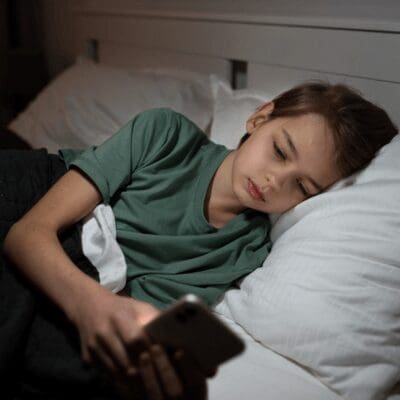
The American Academy of Pediatrics recommends keeping screens out of bedrooms, especially at night, and turning off screens at least 60 minutes before bedtime. The Royal Children’s Hospital poll also notes that screens and caffeine can lead to poorer sleep quality and delay a child’s ability to fall asleep.
This is not about shaming parents.
Screens are convenient. They are everywhere. And sometimes they are the only thing that gives a family a quiet moment.
But for many children, the brain does not read screens as rest.
It reads them as input.
More light. More sound. More novelty. More dopamine. More emotional content. More stimulation.
Then we ask the brain to go from “fully engaged” to “deep sleep” in ten minutes.
That is a hard shift.
5. Your Teen’s Body Clock May Be Shifting Later
Teen sleep is its own category.
During adolescence, sleep timing naturally shifts later. The American Academy of Pediatrics notes that sleep-wake cycles begin to shift up to two hours later at the start of puberty, while many schools still require teens to wake early.
So when your teen says, “I’m not tired,” they may be telling the truth.
That does not mean there should be no boundaries. It means the plan has to respect biology.
Late-night phones, caffeine, homework stress, sports schedules, and early school start times can make this even harder. The CDC reports that students who do not get enough sleep are more likely to have attention and behavior problems that may affect school performance.
Most families need more than willpower. They need a plan that fits what the child or teen is actually struggling with.
When Sleep Problems May Need Medical Review
Some sleep struggles should not be handled with bedtime routines alone.
If your child snores often, gasps, seems to stop breathing, breathes heavily at night, wakes repeatedly, is unusually sleepy during the day, or has major attention and behavior changes, it is worth talking with your pediatrician.
The American Academy of Pediatrics lists frequent snoring, breathing problems at night, daytime sleepiness, difficulty paying attention, and behavior problems as possible signs of sleep apnea in children. It also notes that an overnight sleep study may be recommended after a pediatric exam.
Other patterns to bring up with your child’s medical provider include:
- Loud snoring or gasping
- Mouth breathing at night
- Pauses in breathing
- Restless sleep
- Crawling or uncomfortable feelings in the legs
- Ongoing nightmares or night terrors
- Sudden daytime sleep attacks
- Persistent low mood
- Major anxiety around bedtime
- Falling asleep at school
- Sleep problems that keep getting worse
The Royal College of Psychiatrists notes that large tonsils or adenoids, restless legs syndrome, narcolepsy, depression, and substance use in teens can all be connected to sleep problems or daytime sleepiness.
This is why Grey Matters is careful with sleep content.
A Brain Map is not a sleep study. It does not diagnose sleep apnea, restless legs, depression, anxiety, ADHD, autism, or any medical condition. Doctors and qualified medical providers diagnose medical conditions.
But once medical red flags are being addressed, it can also be helpful to look at how the brain is functioning from a regulation standpoint.
Sleep is not separate from the rest of the nervous system. It is connected to attention, emotional control, stress tolerance, sensory processing, and the brain’s ability to shift from alert to calm.
That is where a qEEG Brain Map may offer useful information.
How to Improve Kids’ Sleep
For most families, the primary path toward better rest does not have to be complex; it begins with the power of a predictable rhythm.
A 2022 systematic review and meta-analysis1 found that behavioral sleep interventions significantly reduced child sleep problems in the studies reviewed. The authors also noted that more research is needed across ages, timing, and intervention types, which is an important reminder not to oversell any one approach.
A 2024 review in Frontiers in Sleep2 states that education and behavioral approaches remain first-line support for pediatric insomnia, while no medications are FDA-approved for pediatric insomnia in the United States.
So before jumping to supplements, medication questions, or worst-case scenarios, it is usually wise to start with the basics and track what happens.

Practical Steps to Improve Your Child’s Sleep Patterns:
Start with a consistent sleep and wake time.
Try to keep bedtime and wake time as consistent as possible, even on weekends. The goal is not perfection. The goal is a rhythm the brain can recognize.
Create a calming sleep environment.
Reduce unnecessary light, noise, clutter, and stimulation. Blackout shades, a fan, a sound machine, soft bedding, or familiar comfort items may help some children feel safer and more settled.
Use sensory supports thoughtfully.
Some children benefit from approved sensory supports, such as a comfort item, calming pressure, or a weighted blanket. If your child uses a weighted blanket, make sure it is age-appropriate and recommended by a qualified provider.
Move screens out of the sleep routine.
A screen curfew is not punishment. It is nervous system support. Try turning off screens at least 60 minutes before bed. Some children may need 90 to 120 minutes, especially if they are highly sensitive to light, sound, or stimulation.
Build a landing strip before bed.
Many children need a gradual descent into sleep. A rushed bedtime can feel like slamming on the brakes. Try building in 30 to 60 minutes of lower-stimulation time before lights out. Dim the lights. Lower the volume. Reduce choices. Keep instructions simple.
Offer calming activities.
Reading, drawing, stretching, quiet music, breathing practice, a warm bath, or listening to an audiobook may help the brain begin shifting into recovery mode.
Watch for caffeine and sugar.
Caffeine is not just in coffee. Tea, soda, energy drinks, some flavored drinks, chocolate, and pre-workout products may all affect sleep, especially in teens. The Royal Children’s Hospital poll specifically noted caffeine as one of the factors that can delay falling asleep and reduce sleep quality.
Track patterns for two weeks.
A sleep log can be incredibly useful. Track bedtime, wake time, night waking, screen use, caffeine, naps, physical activity, mood, focus, and major stressors. The CDC notes that healthcare providers may use a sleep diary to better understand sleep patterns.
This gives you more than a vague feeling that “sleep is bad.”
It gives you clues.
And clues are where better next steps begin.
What If Bedtime Routines Are Not Enough?
Sometimes families do the routine.
They reduce screens. They keep bedtime consistent. They avoid caffeine. They create a calming bedroom. They try reward charts. They talk to the pediatrician.
And the child still struggles.
This is where it may be time to look more closely at regulation.
Some children are not just resisting bedtime. Their brains may be having trouble shifting states.
From alert to calm.
From stimulated to settled.
From worried to safe.
From sensory overload to quiet.
From fight-or-flight to rest.
This is where brain-based patterns can matter.
At Grey Matters, a qEEG Brain Map gives us a detailed look at brainwave activity and patterns of communication across the brain. It may help identify patterns linked to attention, emotional regulation, sleep, stress tolerance, processing speed, or mental clarity.
Again, this is not a diagnosis.
It is information.
And information can help families stop guessing.
How a Brain Map May Help Parents Understand Sleep Struggles
A qEEG Brain Map is non-invasive and passive. Sensors read brain activity; nothing is sent into the brain.
The appointment typically involves a sensor cap, eyes-open and eyes-closed recordings, and a consultation to review findings and recommendations in plain language.
For a child with sleep struggles, the Brain Map may help the Grey Matters team look at patterns that could be associated with:
- Overactivation
- Underactivation
- Difficulty calming the nervous system
- Attention and regulation challenges
- Stress tolerance
- Processing patterns
- Sleep-related dysregulation
- Emotional overwhelm
The point is not to label the child.
The point is to understand what may be happening beneath the surface.
That is the kind of clarity families deserve.
We are not anti-medication. We are pro-information.
We are not here to replace your pediatrician or tell you what your child does or does not need medically. We are here to add information that may help guide a more thoughtful support plan.
How Brain Training May Support Sleep and Regulation
A Brain Map helps us understand patterns. Brain training is how we begin practicing change.
Neurofeedback is a non-invasive form of brain training that gives the brain real-time feedback about its own activity. Sensors placed on the scalp read brainwave patterns; they do not send anything into the brain.
The feedback may come through sound, video, or visual cues. When the brain moves toward a more regulated pattern, the feedback changes in a way that helps reinforce that pattern.
For a child who struggles with sleep, the goal is not to “make” the child sleep.
The goal is to support the regulation systems that help the brain move from alert, busy, worried, or overwhelmed into a calmer state where sleep can come more naturally.
Over time and with repetition, brain training may help the brain practice shifting states more efficiently. For some children, that may support areas such as emotional regulation, focus, stress tolerance, recovery after overstimulation, and the ability to settle at night.
Neurofeedback is not a guaranteed solution for sleep problems, and it is not a replacement for medical care, therapy, medication guidance, occupational support, or appropriate school support.
But for children whose sleep struggles appear alongside focus problems, emotional outbursts, anxiety-like symptoms, sensory overwhelm, or daytime exhaustion, brain training may be a supportive next step.
Sleep, Focus, and Emotional Regulation Are Connected
Many parents do not search “child sleep assessment” first.
They search things like:
“Why is my child so emotional at night?”
“Why does my child wake up angry?”
“Why can’t my child fall asleep even when tired?”
“Why does my child struggle with sleep and focus?”
“Can anxiety make my child unable to sleep?”
That makes sense because poor sleep rarely stays in the bedroom.
It follows the child into the morning.
The American Academy of Pediatrics notes that sleep problems may show up during the day as difficulty paying attention, zoning out at school, behavior problems, and learning concerns.
A tired brain may look defiant.
An overwhelmed brain may look dramatic.
A dysregulated brain may look like it “won’t listen.”
But the real question is not, “What is wrong with this child?”
The better question is, “What is this child’s brain and body trying to show us?”
When to Get More Support
Consider getting more support if your child’s sleep problems are persistent, worsening, affecting school, creating major family stress, or showing up alongside other symptoms such as anxiety, sensory overwhelm, attention problems, emotional outbursts, headaches, stomach complaints, or daytime exhaustion.
Start with your pediatrician when there are signs of breathing issues, severe daytime sleepiness, major mood changes, unusual leg discomfort, or sudden changes in sleep patterns.
Then, if medical red flags have been addressed or ruled out, it may be helpful to explore functional brain patterns through a Brain Map.
Because sometimes the next step is not another guess.
Sometimes the next step is better information.
Book a Brain Map for Child Sleep and Regulation Concerns
If your child’s sleep struggles are starting to affect focus, mood, behavior, school, or daily life, Grey Matters can help you look at the patterns beneath the surface.
A Comprehensive Brain Map may help identify brain activity patterns linked to sleep, attention, stress tolerance, and emotional regulation. It does not diagnose medical conditions, but it may help guide a personalized brain training plan.
To schedule your child’s Comprehensive qEEG Brain Map at Grey Matters Brain Training Studio in Carmel, Indiana, call 317-215-7208 or Book Online.
Grey Matters Brain Training Studio
13250 Hazel Dell Parkway, Suite 102
Carmel, IN 46033
317-215-7208
greymatters.studio
Final Takeaway
If your child has trouble sleeping, start by looking at the pattern.
Not just bedtime.
The whole pattern.
Screens. Stress. Worries. Sensory input. Caffeine. School pressure. Snoring. Breathing. Restlessness. Focus. Mood. Morning behavior. Recovery time.
Your child’s sleep struggle may be a routine issue. It may be a medical issue. It may be a nervous system regulation issue. It may be several things at once.
That is why the goal is not blame.
The goal is clarity.
Symptoms are clues, not character flaws. And when families understand those clues, they can take a more thoughtful next step.
FAQs About Child Sleep Problems
Neurofeedback may help support brain self-regulation for some children, especially when sleep concerns appear alongside focus challenges, emotional regulation struggles, stress tolerance issues, or sensory overwhelm. Results vary, and neurofeedback should be framed as a supportive brain training option, not a guaranteed solution or replacement for medical care.
No. A Brain Map does not diagnose insomnia, sleep apnea, anxiety, ADHD, autism, depression, or any medical condition. It helps identify functional brain activity patterns that may guide personalized neurofeedback brain training recommendations. Grey Matters clearly states that qEEG Brain Mapping is not a diagnostic tool and does not replace medical diagnosis.
Ask your pediatrician before using melatonin or any sleep supplement. Pediatric sleep problems should be evaluated in context, especially if they are persistent, worsening, or connected to daytime sleepiness, mood changes, snoring, or attention and behavior concerns.
Many children with attention, sensory, emotional regulation, or developmental differences also struggle with sleep. The reason may vary from child to child, so it is important to look at the whole pattern: bedtime routine, sensory needs, anxiety, screen use, breathing, movement, and daytime functioning.
Yes, worry and nighttime fears can make it harder for children to fall asleep or stay asleep. If nighttime worries are ongoing, severe, or affecting daily life, it is worth seeking professional support.
Night waking can happen because of sleep habits, nightmares, anxiety, separation needs, discomfort, snoring, breathing issues, or restless sleep. If your child wakes often and also snores, gasps, breathes heavily, or seems very tired during the day, talk with your pediatrician.
Your child may take a long time to fall asleep because of inconsistent routines, screen use, anxiety, overtiredness, caffeine, sensory overload, or a delayed body clock. Teens may also naturally feel sleepy later because sleep timing shifts during adolescence.
References
1. Park, J., Kim, S. Y., & Lee, K. (2022). Effectiveness of behavioral sleep interventions on children’s and mothers’ sleep quality and maternal depression: a systematic review and meta-analysis. Scientific Reports, 12(1), 4172.
2. Dhir, S., Karim, N., Berka, H., & Shatkin, J. (2024). Pharmacological management of pediatric insomnia. Frontiers in Sleep, 3, 1389052.